

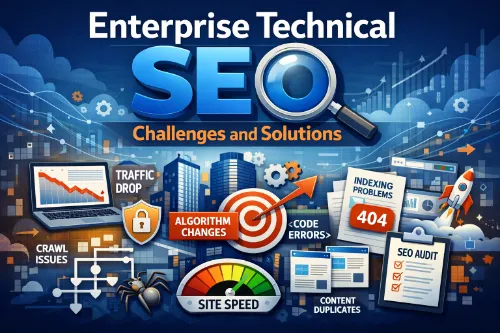
What Is Enterprise Technical SEO?
Enterprise technical SEO is the process of optimizing large, complex websites so search engines can efficiently crawl, index, and understand them at scale. These sites often span thousands or millions of URLs across multiple domains, regions, and legacy platforms. If you want a broader view of how different SEO services fit together with technical work, you can read this guide on SEO services.
Compared to small business SEO, enterprise SEO involves more stakeholders, slower release cycles, and a higher risk that technical issues quietly erode performance over time. That is why you need systems, governance, and automation in addition to one‑off fixes, often supported by structured enterprise SEO services for large websites.
Why Enterprise Technical SEO Is So Challenging
Several factors make technical SEO harder in an enterprise environment than on a typical brochure site.
- Huge URL inventories and complex architecture
- Legacy or proprietary CMS platforms that are difficult to change
- Distributed teams across regions and time zones, from SEO and marketing to product and engineering
- Multiple brands, subdomains, and international sites sharing overlapping content
- High dependency on JavaScript, experimentation tools, and personalization engines
To understand how these issues show up in day‑to‑day work with stakeholders, it helps to align expectations early; this guide on what SEO clients need to know covers many of the conversations you will have at enterprise level.
If you ignore these enterprise technical SEO challenges, crawl budget is wasted, important pages drop out of the index, and competitors outrank you for critical commercial queries. A dedicated enterprise technical SEO challenges and solutions resource can support your internal education efforts.
Challenge 1: Site Architecture and URL Structure
Large websites often grow through mergers, rebrands, and product launches, leaving behind a messy architecture. Symptoms include deep click paths, duplicate categories, and hard‑to‑read URLs.
Typical problems:
- Disorganized hierarchy that hides key content more than three clicks from the homepage
- Parameter‑driven URLs creating near‑infinite combinations for filters and search results
- Inconsistent URL patterns across products, services, and regions
Practical solutions:
- Design a logical, shallow hierarchy with clear hubs (pillars) and spokes (supporting pages).
- Standardize URL patterns and avoid unnecessary parameters where possible.
- Use internal linking to highlight high‑value pages and simplify navigation for both users and crawlers.
For ecommerce and catalog‑style brands, getting this right on category pages is critical; see these category page SEO best practices for ecommerce to align your architecture with how people and search engines browse. For broader on‑page foundations that sit on top of the architecture, you can reference on‑page SEO basics and this on‑page SEO checklist for service‑based websites.
A clean architecture improves crawl efficiency, user experience, and relevance for AI Overviews and answer‑style SERP features because content is easier to interpret and map to search intent. That is also why optimize landing pages for search engines is a useful companion when you redesign templates.
Challenge 2: Crawl Budget and Indexability
At enterprise scale, crawl budget becomes a real constraint. Search engines will not crawl every low‑value URL, so wasted budget means important money pages may be discovered late or crawled less often.
Common crawl and index issues:
- Infinite spaces created by filters, paginated lists, and on‑site search results
- Thin or duplicate content bloating the index
- Important sections buried so deep that crawlers rarely reach them
Crawl‑friendly solutions:
- Use robots.txt to block obvious low‑value paths and control how search engines explore your site.
- Maintain segmented XML sitemaps for products, categories, and content types to guide discovery.
- Apply noindex to thin or utility pages and deindex legacy content that never earns traffic.
- Run regular crawl and log‑file analysis to see what bots actually hit and adjust your rules.
A focused technical SEO audit will quickly expose crawl waste, index bloat, and deeper technical SEO issues hurting performance. To understand where audits fit into a wider strategy, you can also compare website SEO audit vs full SEO strategy and see how SEO audit services are typically structured for large brands.
This index management strategy aligns with modern SEO, GEO, and AEO expectations because you are helping search engines find the right localized, intent‑matched content quickly. If you manage thousands of URLs, the guide on managing SEO for thousands of pages is especially relevant.
Challenge 3: Page Speed and Core Web Vitals at Scale
Enterprise sites often rely on heavy JavaScript, complex tag stacks, and numerous third‑party scripts. This makes it hard to meet Core Web Vitals targets consistently across templates and markets.
Typical performance issues:
- Slow Largest Contentful Paint from large hero images and render‑blocking scripts
- Poor responsiveness from complex components and unoptimized code
- Layout shifts caused by lazy‑loaded ads, widgets, or images
Scalable performance improvements:
- Set performance budgets for each template and enforce them in your CI/CD pipeline.
- Use CDNs, image compression, next‑gen formats, and caching to reduce load times globally.
- Minify and defer non‑critical JavaScript and CSS, and remove dormant tags and pixels.
- Monitor Core Web Vitals regularly and prioritize fixes for your highest‑traffic templates.
For a deeper dive into performance, share or internally reference the guide on how page speed impacts SEO performance along with this overview of Core Web Vitals for SEO. These resources make it easy to explain why performance is not just a dev concern but a revenue concern.
Challenge 4: JavaScript Rendering and Dynamic Content
Modern enterprise front‑ends often ship as single‑page apps or rely heavily on client‑side rendering. This can lead to indexation issues if key content is not available to crawlers.
Frequent rendering problems:
- Essential content or links only visible after user interaction or late JS execution
- Blocked JS or CSS files that prevent rendering and understanding of the layout
- Fragmented or duplicate states of the same page exposed as different URLs
Solutions for JS SEO:
- Use server‑side rendering or hybrid rendering for core templates so HTML contains meaningful content on first load.
- Test how search engines see your pages using rendering tools, and adjust critical paths.
- Avoid injecting key on‑page SEO elements (titles, meta, structured data) solely via client‑side JS when possible.
Because JS problems often surface first as crawl or ranking anomalies, building a habit of recurring technical SEO audits and understanding how often you should get an SEO audit keeps you ahead of issues.
Challenge 5: Duplicate Content, Canonicals, and International SEO
Enterprise businesses often operate multiple brands, subdomains, and country sites. This increases the risk of duplicate content and conflicting signals.
Typical duplication patterns:
- Product variants sharing near‑identical descriptions and attributes across regions
- Printer‑friendly or parameterized versions of the same content
- Multiple language versions without correct hreflang implementation
Canonical and GEO‑friendly solutions:
- Define a canonicalization framework that prioritizes the primary version of each resource and applies consistent rel=canonical tags.
- Configure URL parameters in your analytics and monitoring tools to avoid unnecessary index bloat.
- For international SEO, use hreflang tags or sitemaps to map each language and region version and reduce cannibalization between markets.
- Align your domain strategy (ccTLDs, subfolders, subdomains) with business priorities and governance capabilities.
To see how this plays out in real‑world GEO scenarios, read how enterprise SEO supports global brands and the guide on local SEO ranking factors for multi‑location brands.
Challenge 6: Internal Linking at Enterprise Scale
Internal linking is one of the most powerful yet underused levers in enterprise SEO. As sites grow, links become unevenly distributed, and new sections may remain “orphaned.”
Common internal linking issues:
- High‑value pages only reachable through search or deep navigation
- Overreliance on automated related‑content modules with weak anchor text
- Poor integration between blogs, resources, and commercial pages
Scalable internal linking strategies:
- Identify pillar pages for key topics and build structured linking from supporting assets.
- Use templates and modules that surface top categories, best sellers, or most‑read content across your site.
- Regularly crawl and analyze internal link graphs to find orphaned pages and weak clusters.
Because internal linking is such a critical ranking lever, it is worth studying this focused guide on how internal linking improves rankings. For ecommerce, pair it with product page SEO tips that improve organic sales to ensure revenue pages receive sufficient internal authority.
Challenge 7: Structured Data, AEO, and AI Overviews
Answer Engine Optimization (AEO) and AI Overviews rely on clear signals about entities, relationships, and page purpose. Structured data is a key bridge between your content and modern search features.
Typical issues with schema markup:
- Inconsistent or incomplete structured data across templates and locales
- Use of schema types that do not match the actual content
- No process for validating, monitoring, and updating schema at scale
Enterprise‑ready schema solutions:
- Standardize schema types (Product, Article, FAQ, Review, Organization, Breadcrumb, etc.) and bake them into your CMS templates.
- Use automated tools or internal scripts to generate and validate structured data sitewide.
- Track schema coverage and error rates in search tools and prioritize high‑impact templates first.
To maximize the impact of schema and on‑page signals, align this technical work with content optimization vs keyword stuffing and broader content SEO services: strategy, writing and optimization, so pages stay natural and user‑focused.
Challenge 8: Data, Monitoring, Automation, and Governance
Manual audits alone cannot keep up with an enterprise site. Without automation and governance, issues go unnoticed until traffic drops.
Typical monitoring gaps:
- No unified view across multiple tools and properties
- Infrequent crawls that miss regressions introduced by new releases
- Limited log‑file analysis due to data volume and fragmentation
Automation‑driven solutions:
- Centralize SEO data (crawls, rankings, analytics, logs) into a shared reporting environment.
- Schedule recurring crawls for key properties and set alerts for critical issues like spikes in 404s or drops in indexed pages.
- Build or adopt dashboards that surface crawl waste, index coverage, and technical health metrics at a glance.
For a process‑driven perspective, review SEO governance for large organizations and automation opportunities in enterprise SEO, then decide where automation can safely handle alerts, reports, and checks.
Governance and automation must also connect to commercial metrics. These resources on how to measure SEO ROI for your business, SEO KPIs every business owner should track, and SEO reporting metrics clients actually care about help you tell that story.
Challenge 9: Connecting Technical SEO to Broader SEO Strategy
Technical SEO is powerful, but it works best when connected to keyword research, on‑page optimization, content strategy, and off‑page signals.
Key adjacent areas to align:
- Keyword research and mapping: use keyword research services for lead generation, commercial vs informational keywords in SEO campaigns, and keyword mapping for service pages and blogs to structure intent‑led architecture.
- Content planning: study SEO content planning for topical authority and how blog clusters support SEO service pages so your technical work elevates topical clusters, not isolated URLs.
- Link building and digital PR: complement technical fixes with link building services, understand how backlinks affect domain authority and rankings, and follow white hat vs black hat SEO link building best practices.
For leadership, it is helpful to compare SEO consultant vs SEO agency and learn what to expect from an SEO strategy consultant so they understand how technical programs are supported.
How to Build an Enterprise Technical SEO Roadmap
To turn these challenges and solutions into a roadmap that can rank and perform in Google SERPs, follow a simple sequence.
- Run a full technical audit focused on architecture, crawl budget, performance, and duplication, using a structured technical SEO audit or broader SEO audit services.
- Map findings to business value by connecting each issue to lost traffic, conversions, and risk, and learn what to do after an SEO audit.
- Prioritize fixes using a clear framework (impact, effort, risk, and alignment with strategic goals) and validate with enterprise SEO services for large websites.
- Align with teams in engineering, product, content, and regional markets to secure resources, supported by SEO consulting for in‑house marketing teams or fractional SEO support.
- Implement tracking, automation, and governance so improvements are preserved and scaled, using lessons from SEO wins from technical fixes alone and other case studies.
When you combine solid technical foundations with clear information architecture, structured data, and strong governance, your enterprise website becomes easier for both people and search engines to understand. That is exactly what modern SEO, GEO‑targeted search, and AI‑driven SERP experiences reward.
Frequently Asked Questions
1. What makes enterprise technical SEO different from regular technical SEO?
Enterprise technical SEO focuses on large, complex websites with thousands or millions of URLs, multiple teams, and strict release processes, so you need systems, automation, and governance rather than one‑off fixes.
2. How often should an enterprise website run a full technical SEO audit?
Most large sites benefit from a comprehensive technical SEO audit at least once or twice a year, supported by lighter monthly or quarterly crawls to catch regressions early.
3. Which technical SEO issues are most common on large websites?
Common issues include crawl budget waste, duplicate content, disorganized architecture, slow Core Web Vitals, JavaScript rendering errors, and weak internal linking.
4. What tools are best for auditing an enterprise‑level site?
Enterprises often rely on a mix of enterprise crawlers, log‑file analysis tools, and platforms like Google Search Console and analytics to cover crawlability, performance, and indexation at scale.
5. How do I know if my enterprise site has a crawl budget problem?
Signs include bots spending most of their time on parameter URLs, filtered pages, or legacy content while important money pages are crawled infrequently or show stale cache dates.
6. Is JavaScript a problem for enterprise technical SEO?
JavaScript itself is not bad, but heavy client‑side rendering, delayed content, and blocked resources often create indexation and rendering gaps that hurt organic visibility on large sites.
7. Should enterprise sites use server‑side rendering (SSR) or client‑side rendering?
For critical templates like category, product, and core content pages, SSR or hybrid rendering is usually safer because search engines and AI systems can access content without relying on complex client‑side execution.
8. How important are Core Web Vitals for enterprise SEO?
Core Web Vitals are important ranking and UX signals, and small improvements across high‑traffic templates can significantly affect conversions and overall organic performance at enterprise scale.
9. What is the role of structured data in enterprise technical SEO?
Structured data helps search engines understand entities, relationships, and page purpose, increasing eligibility for rich results and improving how AI models interpret your brand across many URLs.
10. How can I manage duplicate content across multiple brands or regions?
Use a clear domain and URL strategy, canonical tags, hreflang where needed, and content governance to prevent uncontrolled duplication across brands, country sites, and product variants.
11. What is “context parity” and why does it matter?
Context parity means that what users see and what search engines see are consistent; mismatched content due to JS, tests, or personalization can confuse algorithms and reduce trust.
12. How do internal links influence enterprise SEO performance?
Internal links control how authority flows through your large site, so structured linking to pillars and key commercial pages is essential for rankings and for helping crawlers prioritize important content.
13. How should enterprise teams prioritize technical SEO tasks?
Use an impact‑versus‑effort framework that scores each ticket on potential revenue lift, risk reduction, and implementation complexity, then align with product and engineering roadmaps.
14. Who should own technical SEO inside a large organization?
Ownership usually sits with an SEO lead or enterprise SEO team that collaborates closely with engineering, product, content, and analytics, backed by clear governance and workflows.
15. How does technical SEO support AI Overviews and answer engines?
Clean architecture, fast pages, structured data, and clear topical clusters make it easier for AI systems to extract accurate, trustworthy answers and to attribute them to your site.
16. Can technical SEO alone fix a declining enterprise site?
Technical SEO can remove big roadblocks and unlock hidden potential, but sustainable recovery usually also requires strong content, smart keyword targeting, and high‑quality backlinks.
17. What KPIs should we track for enterprise technical SEO?
Useful KPIs include index coverage, crawl stats, Core Web Vitals, organic traffic to key templates, error trends (4xx/5xx), and revenue or conversions tied to technical improvements.
18. How long does it take to see results from major technical SEO changes?
For large sites, meaningful changes often take a few weeks to a few months to be fully crawled, indexed, and reflected in rankings and revenue metrics, depending on scale and frequency of bot visits.
19. Do enterprise SaaS and ecommerce sites face different technical SEO challenges?
Yes; SaaS sites often struggle more with JS apps and documentation sprawl, while ecommerce sites battle faceted navigation, product duplication, and complex category structures.
20. How can we keep technical SEO from breaking every time we ship new features?
Embed SEO checks into your development lifecycle with pre‑release crawls, technical acceptance criteria, and post‑deployment monitoring so issues are caught before they hit users or rankings.







