

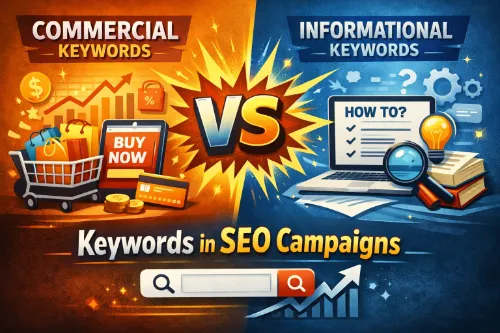
Commercial vs informational keywords
Commercial and informational keywords describe two different types of search intent that you must balance in any serious SEO campaign. Informational keywords bring in people who want to learn, while commercial keywords bring in people who are close to buying, so your strategy should mix both to win visibility, traffic, and conversions on Google SERP, in AI overviews, and across local and global markets.
What are informational keywords?
Informational keywords are search queries people use when they want to learn, research, or understand something, not buy right away. In SEO campaigns, these terms usually match the “discovery” and “interest” stages of the marketing funnel, where users are just starting their journey and asking broad questions about SEO services, technical SEO issues, or why rankings dropped even with SEO work.
Common informational keyword modifiers include:
- “how to”
- “what is”
- “why”
- “guide”
- “tips”
- “examples”
Examples of informational keywords:
- “how to do keyword research for SEO”
- “what is commercial intent in SEO”
- “why search intent matters for Google rankings”
- “what small businesses should expect from SEO packages” (great anchor for linking to what small businesses should expect from SEO packages)
If your content answers these questions clearly and in depth, you can win top positions, People Also Ask, and featured snippets for these searches, as well as earn visibility in AI‑generated overviews.
What are commercial keywords?
Commercial keywords are search queries people use when they are actively comparing options and getting ready to buy a product or service. These searches sit between pure information and full transaction and usually correspond to the consideration stage in the marketing funnel, where users are evaluating different SEO services or trying to compare SEO proposals from different agencies.
Common commercial keyword modifiers include:
- “best”
- “top”
- “reviews”
- “vs”
- “comparison”
- “alternatives”
- “pricing”
Examples of commercial keywords:
- “best SEO services for small business owners” (ideal to support with affordable SEO services for small business owners)
- “top local SEO services for dentists” (connect to local SEO for dental clinics and healthcare providers)
- “SEO consultant vs SEO agency” (link to SEO consultant vs SEO agency)
Commercial keywords are usually more competitive but deliver higher conversion rates and stronger ROI when you rank well for them.
Informational vs commercial keywords: key differences
| Aspect | Informational keywords | Commercial keywords |
|---|---|---|
| Main intent | Learn, research, understand a topic. | Compare options, evaluate products, prepare to buy. |
| Funnel stage | Awareness and interest (TOFU). | Consideration and evaluation (MOFU/BOFU). |
| Common modifiers | how, what, why, guide, tips. | best, top, review, vs, comparison, pricing. |
| Typical content | Blog posts, guides, tutorials, FAQs. | Listicles, comparisons, reviews, buying guides. |
| Traffic potential | Broad audience; higher impressions. | Lower volume but more targeted traffic. |
| Conversion impact | Indirect; nurtures leads over time. | Direct; higher likelihood of conversions. |
Both types are essential: informational keywords feed your pipeline; commercial keywords turn that interest into leads and sales.
Why both keyword types matter for SEO campaigns
Search engines now focus heavily on matching content to user intent, not just keywords. If you only target commercial keywords, you miss a huge top‑of‑funnel audience; if you only target informational keywords, you attract traffic that may never convert properly into leads or clients for your SEO services business.
Key reasons to use both:
- You cover the full customer journey from first question to final decision.
- You increase your chances to appear in AI overviews, featured snippets, and listicles for different intents.
- You build brand authority with informational content and monetize that authority with commercial content and strong CTAs to hire an SEO consultant or request SEO audit services.
A balanced keyword strategy also supports topical authority across clusters like technical SEO services, content SEO services, and local SEO services for small businesses.
Search intent and how it drives rankings
Search intent (keyword intent) is the real goal behind a search query. In modern SEO, understanding search intent often matters more than exact keyword matching because intent determines which content types will rank and convert.
The main kinds of search intent are:
- Informational intent: users want to know something, like “how often should you get an SEO audit?” (you can answer and send them to how often should you get an SEO audit?).
- Commercial intent: users want to research options, like “best local SEO services” or “monthly SEO services vs one‑time SEO projects” (perfect anchor to monthly SEO services vs one-time SEO projects).
- Transactional intent: users want to take action, like “hire SEO agency”, “buy SEO package”, or “book technical SEO audit”.
- Navigational intent: users want a specific brand or resource, like “SEO Mafia Club guides” (you can centralize these on your guides hub).
Matching your content format to the dominant search intent is one of the most important ranking moves you can make.
Common modifiers that signal keyword intent
1. Informational keyword modifiers
These signal that the searcher is looking for information, often aligning with resources like:
Typical modifiers:
- how
- what
- why
- guide
- tutorial
- checklist
- tips
- examples
2. Commercial keyword modifiers
These signal that the searcher is comparing solutions, pricing, or providers, which you can support with pages like:
Typical modifiers:
- best
- top
- review
- vs
- comparison
- alternatives
- pricing
- cost
When you audit your keyword list, grouping queries by these modifiers is a fast way to separate informational vs commercial keywords and map them to the right guide.
Content types for informational vs commercial keywords
Choosing the right content type for each intent gives you a better chance to rank and to funnel users into relevant guides.
1. Best content for informational keywords
For informational keywords, clear, structured, educational content works best. Examples from your library:
- Technical tutorials such as technical SEO audit and enterprise technical SEO challenges and solutions.
- On‑page guides like on-page SEO checklist for service-based websites and content optimization vs keyword stuffing.
- Strategy explainers such as search intent optimization for better rankings and SEO content planning for topical authority.
These pieces should answer questions directly, use simple language, and provide checklists or step‑by‑step processes.
2. Best content for commercial keywords
For commercial keywords, comparison and decision‑support content performs best, including:
- Service pages like off-page SEO services, link building services, and ecommerce SEO services for online stores.
- Package and pricing guides such as what’s included in SEO packages and guaranteed SEO services.
- “Choose the right partner” guides like how to choose the right SEO agency and questions to ask before hiring SEO services.
This content should highlight benefits, compare options, and end with strong calls to action.
How informational and commercial keywords fit in the funnel
Informational and commercial keywords sit at different stages of the marketing funnel.
- TOFU: informational keywords attract a broad audience and build awareness; your traffic vs leads and SEO wins from technical fixes alone posts are great here.
- MOFU: commercial keywords help users compare solutions, supported by pages like commercial intent clusters or agencies find low competition high intent keywords.
- BOFU: transactional keywords align with pages where users contact you after reading about SEO audit services or fractional SEO support for growing businesses.
A strong campaign connects these stages with strategic internal links.
Practical example: connecting informational and commercial keywords
Imagine a local service business in the Philippines. A clean journey could look like this:
- Informational: user searches “why some SEO campaigns fail”; your guide why some SEO campaigns fail educates them.
- Commercial: they then look for “affordable SEO services for small businesses”; you link to affordable SEO services for small business owners.
- Transactional: after reading case studies like local SEO success story for a Philippine business, they reach out for a proposal.
This journey shows how informational and commercial keywords work together in a realistic GEO context.
How to find informational and commercial keywords
Use tools and your existing content hub to identify and expand your keyword coverage.
- Start with your topic clusters: technical SEO, local SEO, ecommerce SEO, enterprise SEO, SEO audits, keyword research, SEO consulting, and industry‑specific clusters.
- Use your foundational content, like keyword research services for lead generation and keyword mapping for service pages and blogs, to drive deeper research.
- Build sub‑clusters around pages such as commercial vs informational keywords in SEO campaigns and long-tail keywords for SEO services businesses.
From there, you can expand with related informational questions and commercial modifiers for each cluster.
Steps to build a balanced SEO keyword strategy
- Map your services and niches
- Use guides like industry-specific clusters to clarify what you want to rank for.
- Research search intent
- Lean on search intent optimization for better rankings to classify queries as informational, commercial, transactional, or navigational.
- Build clusters for each intent
- For example, local SEO cluster: local SEO services for small businesses, local SEO audit guide, local citation building.
- Plan internal links
- Use tips from internal linking improves rankings and how blog clusters support SEO service pages.
- Optimize on‑page SEO
- Check on-page SEO services and optimize landing pages for search engines for best practices.
- Monitor KPIs and ROI
- Use how to measure SEO ROI for your business and SEO KPIs every business owner should track to evaluate impact.
- Refresh and scale
- Revisit content using content refresh services for old website pages and scale success with automation opportunities in enterprise seo.
To make this content GEO‑aware, you can sprinkle in location modifiers (for example “local SEO services for Philippine clinics and law firms”) and then support them with deep guides like local SEO helps clinics law firms and restaurants and local SEO strategies for property listings.
For AEO and NLP:
- Use clear, question‑based headings that AI overviews can summarize.
- Keep answers short and direct near the top of each section.
- Support complex topics (like core web vitals for SEO or page speed impacts SEO performance) with concise definitions and bullet lists.
- Informational keywords target people who want to learn and work best with guides, tutorials, and cluster content like your SEO guides hub.
- Commercial keywords target people comparing options and are ideal for service pages, pricing explainers, and decision‑support content such as how to choose the right SEO agency.
- Your site already has strong assets across technical SEO, local SEO, ecommerce SEO, enterprise SEO, SEO audits, keyword research, and consulting, which you can interlink around commercial vs informational keywords in SEO campaigns as a core hub.
- By combining smart keyword mapping, topical clusters, and structured internal linking, you can support both AI‑driven search experiences and traditional organic rankings.
Frequently Asked Questions
1. How do I quickly tell if a keyword is informational or commercial?
Look at the wording and the SERP.
If the keyword contains “how,” “what,” or “why” and the results are mostly guides and blogs, it is informational.
If it includes “best,” “vs,” “review,” or “pricing” and the results are listicles, reviews, or service pages, it is commercial.
2. Can one page target both informational and commercial keywords?
Yes, but you should still prioritize one dominant intent.
For example, a commercial listicle can start with a short informational intro that answers a “what is” question and then shift into a “best tools” list.
Just avoid mixing multiple strong intents that confuse Google and readers.
3. Should I build separate clusters for informational and commercial keywords?
Ideally, yes.
Create informational clusters around topics (guides, how‑tos, explainers) and commercial clusters around services or products (best, reviews, comparisons).
Then connect clusters with internal links to guide users from learning to buying.
4. Do informational keywords still matter if my main goal is lead generation?
Very much so.
Informational keywords bring in people early in their journey, let you capture attention, and give you chances to build trust and email lists.
Those users later convert through commercial and transactional pages if your funnel is set up well.
5. Are commercial keywords always harder to rank for?
Not always, but often.
“Best” and “review” queries in competitive niches can be tough, while long‑tail commercial keywords like “best SEO package for local restaurants in [city]” can be surprisingly attainable.
Difficulty depends on niche, domain strength, and content quality.
6. How many informational vs commercial keywords should I target in a new SEO campaign?
There is no fixed ratio, but a useful starting point is something like 60–70% informational and 30–40% commercial.
The informational content builds reach and topical authority, while the commercial content converts that authority into revenue.
You can shift the mix over time based on results.
7. Do commercial keywords always have higher conversion rates?
They usually do, but context matters.
If the page that ranks for a commercial keyword is weak, slow, or misaligned, conversion rates can still be poor.
Good UX, offers, and trust elements are just as important as the keyword itself.
8. Can informational content directly bring in clients or sales?
Yes, especially when it shows your expertise and includes subtle conversion paths.
A strong how‑to guide can convert via in‑content CTAs, lead magnets, or links to relevant service pages.
It is indirect, but the intent can still move toward action on the same visit.
9. Should my homepage focus on commercial or informational keywords?
Your homepage is usually best used for broad brand and commercial intent.
It should focus on who you serve, what you offer, and why you are different, not detailed how‑to education.
Use inner pages and blogs for informational queries.
10. How does search intent affect my title tags?
Your title tag should reflect the query’s intent as clearly as possible.
For informational keywords, titles like “How to…” or “Guide to…” work well; for commercial keywords, “Best…”, “Top…”, or “Service Name + Location” are stronger.
Aligning titles with intent improves both CTR and rankings.
11. Can I run paid ads on the same commercial keywords I target in SEO?
Yes, and it often works well.
Owning both paid and organic visibility on high‑value commercial keywords can significantly increase click share and conversions.
It also lets you test which messages and offers resonate before baking them into SEO pages.
12. How often should I revisit my commercial keyword list?
At least every quarter.
Markets, competitors, and search behavior change, and new tools or services appear.
Regular reviews help you discover new long‑tail opportunities and retire underperforming targets.
13. Do AI overviews change how I choose commercial vs informational keywords?
They change how you structure content more than what you target.
You still need both keyword types, but you should write concise, answer‑driven sections for informational terms and clear, well‑structured comparisons for commercial terms.
This makes your pages easier for AI overviews to surface.
14. Is it risky to optimize a service page for informational keywords?
It can be if you ignore user intent.
If a query is clearly informational and you send users to a hard‑selling service page, they may bounce quickly.
Better to let a blog or guide rank and then guide users to the service page via internal links.
15. How do I avoid keyword cannibalization between informational and commercial pages?
Give each page a clear role and main keyword.
Use one page as the primary target for a specific commercial query, and let other pages support it with internal links rather than trying to rank multiple pages for the same exact term.
Distinct angles and intents help avoid overlap.
16. Do local businesses need commercial and informational keywords too?
Yes, especially in competitive cities or verticals.
Informational content like “how to pick a good [service] provider in [city]” attracts early‑stage searchers, while commercial pages like “[service] in [city]” convert them.
Local GEO modifiers just add another layer on top of intent.
17. How do I track performance separately for informational and commercial keywords?
Tag and group your pages and keywords by intent in your analytics and SEO tools.
Create dashboards or segments for informational traffic vs commercial traffic, and track conversions and assisted conversions separately.
This shows which parts of your funnel are doing the real work.
18. Can a single keyword shift from informational to commercial over time?
Yes, as products, markets, or user behavior evolve.
A phrase that started as mostly educational can become more commercial as people associate it with specific tools or brands.
Re‑checking SERPs periodically helps you adapt your content to the current intent.
19. How do long‑tail keywords fit into informational vs commercial strategy?
Long‑tail queries often have very clear intent and lower competition.
Informational long tails are great for building topical depth, while commercial long tails like “best [niche] SEO services for [industry]” are excellent for highly qualified leads.
They are especially powerful for small and mid‑size sites.
20. What is the biggest mistake people make with commercial vs informational keywords?
The biggest mistake is treating all keywords the same.
They write one generic type of content for everything and ignore how differently users behave at each intent stage.
Successful campaigns respect intent, assign a clear role to every page, and connect those pages into a deliberate path from question to conversion.







