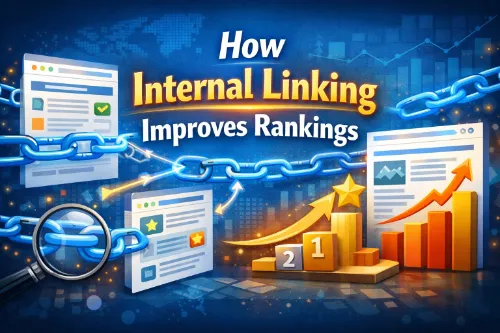
Internal linking improves rankings helps search engines crawl, understand, and rank your content more effectively while guiding users to the most valuable pages on your website. By connecting related pages with clear, keyword‑rich anchor text, you strengthen topical authority, distribute link equity, and support better engagement signals that feed modern SEO, GEO, and AEO algorithms. When combined with solid SEO services and regular audits, internal linking becomes a simple, scalable strategy that can significantly boost organic traffic and conversions.
What Is Internal Linking and Why It Matters
Internal links are hyperlinks that connect one page on your website to another page on the same domain. Unlike external links that point to other sites, internal links help search engines and users move logically through your own content, products, and services. A strong internal linking structure works alongside your on‑page SEO basics and technical SEO services to improve crawlability, indexing, and user experience. When done right, internal links support NLP and AI systems by making relationships between topics, entities, and clusters clearer. This is critical for AI Overviews and answer engines, which rely on clearly structured, semantically connected content.
For many websites, internal linking issues show up first in a technical SEO audit, where orphan pages, thin navigation, and broken links are common findings. Fixing these internal linking problems, together with technical SEO issues, often leads to faster indexing, better rankings, and more stable visibility. Internal linking also supports other core areas like content optimization vs keyword stuffing by helping you emphasize relevance through structure rather than overusing keywords on a single page.
How Internal Linking Improves Rankings
1. Better Crawlability and Faster Indexing
Search engines discover new content by following links, and internal links are the primary paths they follow inside your site. If important pages—like service landing pages or key blog guides—are buried with few or no internal links, crawlers may not revisit them frequently, and rankings can stagnate. A clean internal linking structure, supported by technical SEO services, reduces crawl depth and ensures high‑value URLs are reachable in just a few clicks. This makes it easier for bots to process changes, new sections, or refreshed content at scale, especially on large or enterprise websites.
Sites that implement a thoughtful internal linking strategy often see measurable improvements, such as more pages being indexed and increases in organic traffic. Combining internal linking improvements with a website SEO audit and fixes to core web vitals and page speed performance can compound those gains even further.
2. Distributing Link Equity
Some pages naturally attract more backlinks and authority—think flagship guides, viral content, or PR features. Internal links allow you to distribute this link equity to deeper URLs like service pages, product pages, or niche resources that don’t earn many backlinks on their own. This is especially powerful when combined with external link building services and best practices like evaluating backlink quality.
Internal linking also supports your broader off‑page strategy. When you run digital PR vs traditional link building campaigns, you can funnel that external authority into a smart internal web of related pages. Guides such as how backlinks affect domain authority and rankings and white hat vs black hat link building make it clear that link equity is most effective when supported by a strong internal structure.
3. Building Topical Authority with Topic Clusters
Modern algorithms reward sites that demonstrate deep topical coverage instead of thin, isolated articles. Topic clusters connect comprehensive pillar pages with focused supporting articles using internal links in both directions. For example, you might have a central pillar like internal linking improves rankings supported by cluster content on on‑page SEO checklists, SEO content planning for topical authority, and how blog clusters support service pages.
You can build similar clusters around local SEO services, ecommerce SEO services, enterprise SEO services, or keyword research services, depending on your business model. Clusters reinforced by internal links help you capture more commercial and informational queries, including commercial vs informational keywords, long‑tail keywords for SEO service businesses, and buyer‑intent ecommerce keywords.
4. Improving User Experience and Engagement Signals
Internal links also serve users, not just bots. When readers land on a guide about search intent optimization, they might naturally want to explore related topics like content SEO services or SEO content planning. Well‑placed links keep them engaged, increase pages per session, and reduce bounce, all of which correlate with better organic performance.
Case studies such as SEO wins from technical fixes alone, content‑led SEO growth, and local SEO success for Philippine businesses often highlight internal linking improvements as part of the wins. These examples show how better internal navigation supports both traffic vs leads and conversion outcomes by helping visitors naturally move from top‑of‑funnel education to bottom‑of‑funnel offers.
5. Clearer Context with Descriptive Anchor Text
Anchor text is the clickable text of your link, and it sends strong relevance signals. Using descriptive phrases like “on‑page SEO services” linked to your on‑page SEO services guide is far more helpful than generic “click here.” You can safely use a mix of exact‑match anchors (for example, local citation building) and semantic variations (such as local SEO ranking factors) as long as they are natural in the sentence.
This variety helps NLP systems understand your pages across many queries, particularly when you support core topics like SEO consulting vs SEO agency, DIY SEO vs hiring an agency, or how to choose the right SEO agency. Descriptive anchor text also primes users so they know exactly what to expect after clicking, improving trust and click‑through.
9 Practical Internal Linking Best Practices
These simple listicle‑style best practices are designed to be AI Overview‑friendly and easy to implement.
- Map your site structure first
Plan your information architecture around key hubs such as SEO services for small businesses, local SEO helps clinics and restaurants, or SaaS SEO services, then connect supporting content accordingly. - Build topic clusters around services and industries
Use industry‑specific clusters for law firms, medical sites, real estate, SaaS, and ecommerce, each supported by content like local SEO for personal injury law firms or medical content SEO and E‑E‑A‑T. - Prioritize contextual links inside content
Add links in paragraphs where they naturally enhance understanding, such as referencing category page SEO in a guide about ecommerce SEO services. - Use keyword‑rich but natural anchor text
Link phrases users actually search, like local SEO audit guide for Philippine businesses or product‑led SEO strategies for SaaS brands. - Leverage high‑authority and case study pages
From your strongest content, such as how a service business increased leads organically or before and after SEO results, link to priority service and BOFU pages. - Balance link quantity with readability
Use a reasonable number of internal links per article, and avoid turning every second phrase into a hyperlink; this is especially important on pieces like what SEO services can and cannot guarantee or how much SEO services cost. - Connect funnel stages with smart paths
Link TOFU pieces (for example, why SEO is a long‑term investment) to MOFU and BOFU assets like hire an SEO consultant or monthly SEO services vs one‑time projects. - Support analytics and reporting content with deeper links
From guides like SEO KPIs every business should track and SEO reporting metrics clients care about, link to posts about how to measure SEO ROI. - Keep everything maintained with regular audits
Use recurring SEO audit services to identify broken links, thin internal paths, and new opportunities to connect pages like cheap SEO services or questions to ask before hiring SEO services.
Simple Internal Linking Workflow You Can Reuse
- List your core offers and segments
Include items like SEO services for law firms, SEO services for medical websites, SEO services for real estate agencies, SaaS SEO services, and affordable SEO services for small business owners. - Assign related content to each cluster
Map supporting posts like law firm content strategy for organic leads, local SEO for dental clinics, real estate content ideas, or BOFU vs TOFU content in SaaS SEO under the right pillar. - Create internal paths for every journey
For each cluster, link from top‑level guides to more detailed content and then down to decision‑stage pages like what small businesses should expect from SEO packages, what’s included in SEO packages, or best SEO agency traits for long‑term growth. - Support governance and scale for large sites
Use frameworks like SEO governance for large organizations, managing SEO for thousands of pages, and automation opportunities in enterprise SEO to ensure internal linking and enterprise technical SEO challenges remain under control. - Tie everything back to results and expectations
Link educational content like are SEO services worth it for small businesses?, why some SEO campaigns fail, or why rankings dropped even with SEO work to practical pages such as how long SEO services take to work and how to compare SEO proposals.
Internal Linking Checklist (SEO, GEO, AEO Ready)
Before you publish or refresh any major page, quickly review this checklist.
- The page is part of at least one clear topic cluster (services, industry, or funnel stage).
- It links contextually to related guides and services (for example, from SEO consultant vs SEO agency to hire an SEO consultant or fractional SEO support).
- Anchor text is descriptive, keyword‑rich, and written in simple, natural language.
- The page receives internal links from at least one authoritative or high‑traffic article, case study, or hub.
- There are no broken internal links or unnecessary redirect chains.
- The number of links supports readability and UX—no obvious over‑linking.
- Navigation and breadcrumbs make it easy to reach the page from higher‑level hubs.
- The internal links align with search intent and guide users toward the next useful step.
Frequently Asked Questions
Is there such a thing as too many internal links on one page?
Yes. While there’s no fixed limit, excessive internal links can overwhelm users and dilute link equity, so focus on only the most relevant, helpful links per page.
Should I add internal links to very short pages or only long‑form content?
You can add internal links to any page, but long‑form content typically offers more natural places for contextual links and distributes authority more effectively.
Do internal links in navigation menus count the same as links in the main content?
Navigation links are useful for structure, but contextual links within the main body usually send stronger relevance signals to search engines.
Does the position of an internal link on the page matter for SEO?
Yes. Internal links placed higher in the main content and surrounded by relevant text are generally more valuable than links buried in footers or sidebars.
Can I use the same anchor text for multiple internal links to different pages?
It’s better to avoid that. Reusing identical anchor text for different destinations can confuse search engines about which page should rank for that phrase.
What happens if I link multiple times to the same page from a single article?
Google mainly considers the first crawlable link and its anchor text, so you usually don’t gain extra value from repeating internal links to the same URL.
Are nofollow internal links ever a good idea?
Generally no. Most internal links should be followed so crawlers can discover and evaluate your pages, except for URLs you intentionally do not want indexed.
Should I internally link to pages that are blocked in robots.txt?
Linking to blocked pages is not helpful, because crawlers can’t access or index them; it’s better to fix the blocking or remove those links.
Do internal links help new pages get indexed faster?
Yes. Adding internal links from already crawled pages is one of the simplest ways to help new content get discovered and indexed quickly.
How often should I review my internal links on existing content?
A light review every few months, and a deeper audit at least once or twice a year, helps you catch broken links and add new opportunities.
Should I change internal links when I update or refresh old content?
Yes. Updating internal links during content refreshes ensures you point readers to your newest, most accurate, and most authoritative resources.
Is it bad to link internally to a page that redirects (301)?
A few 301s are fine, but it’s more efficient to update internal links to point directly to the final destination instead of going through redirects.
Do faceted navigation and filters count as internal links?
They can, but they may create many similar URLs. You should handle them carefully with canonical tags and a clear linking strategy to avoid index bloat.
How do internal links interact with canonical tags?
Internal links should generally point to the canonical version of a page so that authority and signals consolidate on the preferred URL.
Can internal linking help pages that target very low‑volume keywords?
Yes. Internal links support long‑tail and low‑volume keywords by reinforcing topical relevance and helping those niche pages remain discoverable.
Should I prioritize internal links to commercial or informational pages?
Ideally both. Link informational content to commercial pages for conversions, and commercial pages back to educational resources for depth and trust.
Do internal links affect how sitelinks appear in search results?
They can. Strong, consistent internal linking to key sections helps search engines understand which pages are important enough to appear as sitelinks.
Are image links useful for internal linking, or should I stick to text?
Image links are crawlable, but text links with descriptive anchor text are usually clearer for both users and search engines.
How can I measure the impact of internal linking changes?
Track changes in rankings, organic traffic, crawl stats, and internal click‑throughs for pages that received new or improved internal links.
What tools can help automate or scale internal linking on large sites?
SEO crawlers and dedicated internal linking tools can suggest opportunities, highlight orphan pages, and help you manage links at scale.