

If your business has more than one branch, office, clinic, shop, or service area, local SEO is not just about being visible online. It is about helping every location rank in the right city, for the right search, at the right time.
For multi-location brands, the biggest challenge is simple: you want one strong brand, but you also need each location to feel local. That means your Google Business Profiles, location pages, local citations, reviews, on-page SEO, local content, and backlinks all need to work together. You can support this with professional SEO services and more specialized local SEO services for small businesses when you want extra implementation help.
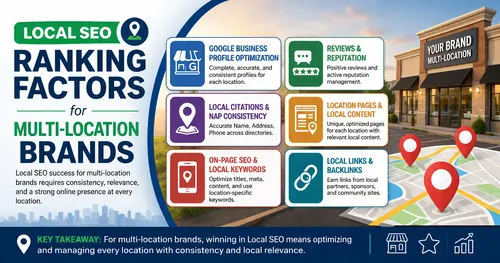
Google says local results are influenced mainly by relevance, distance, and prominence. It also says complete business information, positive reviews, and strong web SEO signals can improve local visibility.
This guide explains the top local SEO ranking factors for multi-location brands in simple English, with practical steps you can apply across all branches without creating thin or duplicate content. It is written to be useful for Google Search, AI Overviews, answer engines, and real users first, which matches Google’s guidance on helpful, reliable, people-first content.
Here is the short answer.
The most important local SEO ranking factors for multi-location brands are:
- Google Business Profile optimization for every branch (you can go deeper with Google Business Profile optimization services)
- NAP consistency across directories and the website (supported by local citation building)
- Unique and useful location pages
- Reviews and reputation management
- Strong local citations
- On-page SEO and local keywords (reinforced by on-page SEO services and on-page SEO basics)
- Local backlinks and authority signals (see off-page SEO services and link building services)
- Accurate business details and structured data
- Good user experience on mobile (including page speed impacts on SEO performance and Core Web Vitals for SEO)
- Strong engagement signals such as clicks, calls, and direction requests
If you want more local visibility, more calls, and more foot traffic, focus on consistency, local relevance, and trust at every location.
Why local SEO matters for multi-location brands
A single-location business only needs to prove one thing: “We serve this area well.”
A multi-location brand needs to prove something harder: “Each of our locations serves its own area well.”
That is why local SEO for multi-location brands is more complex than standard SEO. You are not trying to rank one homepage for every city. You are trying to build local relevance for every branch while protecting your overall brand authority. For a deeper strategic view, see this dedicated guide on local SEO ranking factors for multi-location brands.
This matters because local searchers often have strong buying intent. When someone searches for “dentist near me,” “hardware store in Cebu,” or “best salon in Quezon City,” they are often ready to visit, call, book, or buy. Google’s local systems aim to show nearby businesses that match the search and appear trustworthy.
For multi-location brands, that means each branch needs:
- accurate business information
- a properly optimized Google Business Profile
- a unique location page
- local reviews
- relevant local content
- strong citations and local links
Without those signals, your locations can compete against each other, confuse Google, or fail to rank in map results.
How multi-location SEO differs from single-location SEO
Multi-location SEO is not just “regular SEO repeated many times.” It involves operational discipline. For large sites, concepts from enterprise SEO services for large websites and managing SEO for thousands of pages also apply.
You manage multiple Google Business Profiles
Each location must have the right category, address, hours, contact details, services, photos, and updates. One wrong field can hurt visibility or create confusion.
You need consistent NAP data at scale
NAP means name, address, and phone number. For one location, this is manageable. For 20 or 200 locations, it becomes a serious quality-control issue, which is where structured SEO audit services and local SEO audit guides can help.
You must avoid duplicate location pages
A common mistake is copying one city page and only changing the city name. Google recommends unique, helpful content and discourages pages made mainly for search engines. To stay safe, follow content optimization vs keyword stuffing.
You need local relevance for each branch
Every branch should show why it matters in that local area through local content, service details, nearby landmarks, localized FAQs, reviews, and structured business details.
The top local SEO ranking factors for multi-location brands
Google Business Profile optimization
Your Google Business Profile optimization is one of the strongest local SEO ranking factors for multi-location brands. Google explicitly says that businesses with complete and accurate information are easier to match to relevant searches. If you need a deeper implementation playbook, you can tap into local SEO services or specialized Google Business Profile optimization services.
For each location, make sure you have:
- the correct primary category
- relevant secondary categories
- exact business name
- full address
- local phone number when possible
- accurate business hours
- website URL
- service and product details
- quality photos
- updated holiday hours
- attributes and amenities where relevant
A profile that is incomplete or outdated sends weak trust signals. A well-maintained profile helps Google understand what the branch offers and where it belongs.
For multi-location brands, the best practice is to create a central process for profile management, but still allow local teams to update branch-specific details quickly.
What to do
- Audit every Google Business Profile monthly
- Standardize naming rules
- Use the most accurate categories
- Add real photos from each location
- Keep hours updated, especially on holidays
- Make sure every listing links to the correct location page
NAP consistency across all locations
Local citations and NAP consistency remain critical because Google uses business information from many sources. When your name, address, and phone number differ across directories, maps, social profiles, and your own website, Google and users may lose trust in the data. Local citation building provides a structured way to fix this.
For multi-location brands, NAP consistency must happen at two levels:
- brand-wide consistency in naming style
- location-level accuracy in address and phone details
For example, if one listing says “ABC Dental Center – Cebu IT Park” and another says “ABC Dental Clinic Cebu Branch,” that may create confusion if the brand name is handled inconsistently. The same problem happens when one platform uses an old suite number or an outdated landline.
What to do
- Keep a master database for all locations
- Use one approved format for each business name
- Update all citations after relocations or phone number changes
- Check major platforms, local directories, maps, and niche listings
- Match the NAP on the website, Google Business Profile, and directory listings
Location page quality
One of the biggest ranking opportunities for multi-location brands is the quality of your location pages and local content. This ties directly to on-page SEO checklists for service-based websites and optimize landing pages for search engines.
A great location page should not be a clone. It should be useful, specific, and written for people in that area. Google’s people-first content guidance supports creating unique, original pages that genuinely help users.
A strong location page can include:
- exact business name, address, and phone number
- embedded map
- opening hours
- services offered at that branch
- nearby landmarks
- parking or transport details
- branch photos
- FAQs for local customers
- reviews or testimonials from that location
- staff details if relevant
- local promotions or seasonal updates
- internal links to related services (supported by strong internal linking)
For example, a page for a Manila branch should not read exactly like a page for a Davao branch. It should reflect the local service area, local customer needs, and local proof points.
What to do
- Create one dedicated URL per location
- Write unique intros and FAQs for each branch
- Include local keywords naturally
- Add maps, directions, and landmarks
- Link from the main locations hub to each branch page
- Avoid doorway-style pages with thin content
Reviews and reputation signals
Reviews and reputation are major local trust signals. Google clearly states that more reviews and positive ratings can improve local ranking, and it highlights review score and review count as part of prominence. For some industries this overlaps with vertical guides like local SEO for dental clinics and healthcare providers or local SEO helps clinics, law firms and restaurants.
For multi-location brands, review management should be local, not only national. A brand may have thousands of reviews overall, but if one branch has weak ratings or no recent feedback, that branch can still underperform.
Reviews also influence click behavior. A location with fresh, detailed, positive reviews often gets more attention in local search.
What to do
- Ask customers for reviews after real interactions
- Encourage reviews for the correct branch, not just the brand
- Respond to both positive and negative reviews
- Mention real service context in responses
- Monitor review trends by location
- Use reviews to improve branch operations
Important note
Do not fake reviews or gate reviews. Focus on real customer experience. Strong reputation comes from strong service first.
Local citations and directory listings
Local citations are mentions of your business details on online directories, local platforms, and business databases. For multi-location brands, citations help confirm your branch data across the web. A structured approach like local citation building makes this easier.
While citations alone will not carry your local SEO strategy, they are still foundational. Google uses business information from multiple sources, so consistent listings support trust and discoverability.
Useful citation sources can include:
- general business directories
- map platforms
- chamber of commerce listings
- local business associations
- industry-specific directories
- local news business listings
- franchise portals if relevant
What to do
- Claim top citation sources for every branch
- Remove duplicates
- Fix outdated addresses and numbers
- Prioritize trusted and relevant directories
- Avoid spammy low-quality directory blasts
On-page SEO and local keywords
On-page SEO and local keywords still matter for local rankings because your website helps Google understand your location, services, and relevance. You can reinforce this with on-page SEO services, on-page SEO basics, and guidance on content optimization vs keyword stuffing.
This includes:
- title tags
- meta descriptions
- H1 and H2 headings
- service descriptions
- internal links
- image alt text
- FAQ sections
- schema markup
- crawlable business details
Google’s SEO Starter Guide and structured data documentation emphasize making pages easy to understand for both users and search systems. Structured data can help Google better understand local business details.
Examples of natural keyword use:
- local SEO ranking factors for multi-location brands
- Google Business Profile optimization
- local citations and NAP consistency
- location pages and local content
- reviews and reputation
- on-page SEO and local keywords
- local backlinks and authority
- user experience and mobile optimization
What to do
- Put the city or branch area naturally in the title and H1
- Write meta descriptions that match search intent
- Add service plus city combinations where helpful
- Build internal links from service pages to relevant locations
- Use FAQ content to target common local questions
If you need more help mapping topics to URLs, see keyword mapping for service pages and blogs and search intent optimization for better rankings.
Local backlinks and authority
Local backlinks and authority help strengthen prominence. Google notes that prominence is influenced by signals such as links, articles, and directories. You can deepen this with off-page SEO services, link building services, and explainers like how backlinks affect domain authority and rankings and how to evaluate the quality of backlinks.
For multi-location brands, backlinks should not be only to the homepage. Individual branch pages can benefit from local mentions and links.
Examples of valuable local link sources:
- local news sites
- community organizations
- sponsorship pages
- school or event partnerships
- local chambers of commerce
- local bloggers and city guides
- supplier or partner sites
- industry associations
A branch with local links from trusted organizations often has a stronger local footprint than a branch with no local mention at all.
What to do
- Sponsor relevant local events
- Publish local community updates
- Build partnerships with neighborhood organizations
- Pitch useful stories to local media
- Earn links to specific branch pages when possible
Relevance, distance, and prominence
If you remember only one local SEO framework, remember this: relevance, distance, and prominence.
Google says local results are based mainly on these three factors.
Relevance
Does your location clearly match what the searcher wants?
This depends on:
- business categories
- services listed
- location page content
- local keywords
- complete business details
Distance
How near is the location to the searcher or the area searched?
You cannot control physical distance, but you can make sure Google clearly understands where each branch is.
Prominence
How well-known and trusted is the branch or brand?
This depends on:
- review count and score
- local backlinks
- articles and mentions
- directory presence
- overall web authority
- strong SEO best practices
For multi-location brands, the best strategy is to improve relevance and prominence while making location signals crystal clear.
User experience and mobile optimization
Many local searches happen on mobile. People want quick answers: call now, get directions, check hours, visit the website, or read reviews. That means user experience and mobile optimization are local SEO factors too, even if they are sometimes discussed under broader SEO.
Your location pages should load fast, display key business details high on the page, and work smoothly on phones. You can use guidance from page speed impacts SEO performance and Core Web Vitals for SEO to guide UX improvements.
What to do
- Make the phone number tappable
- Place address, hours, and CTA near the top
- Use simple navigation
- Compress images
- Keep layout clean and readable
- Avoid intrusive pop-ups on mobile
- Add clear buttons for call, directions, and booking
Structured data and business details
Structured data helps search engines understand the content on your pages. Google’s LocalBusiness structured data documentation explains that it can help Google interpret key business details such as hours, departments, and reviews in supported cases.
For multi-location brands, this is useful because every location page can communicate specific details in a machine-readable way. For larger and more complex sites, see enterprise technical SEO challenges and solutions and technical SEO services.
Relevant schema can include:
- LocalBusiness
- Organization
- FAQPage
- BreadcrumbList
- Review, where appropriate and compliant
Google also says AI features in Search can help users find your website, and that website owners should focus on making content accessible and understandable. Clear structure and strong page signals support that goal.
What to do
- Add LocalBusiness schema to each location page
- Use branch-specific data, not generic brand data only
- Validate markup before publishing
- Keep schema aligned with visible page content
- Add FAQ schema only when the page truly contains those FAQs
Behavioral signals and engagement
While Google does not publish a full checklist of every engagement signal, local marketers consistently track actions that reflect real interest, such as clicks from local results, calls, direction requests, website visits, bookings, time on location pages, and conversions by branch.
These are useful because they tell you whether your location pages and listings actually match intent. If people click but do not act, your page may lack trust, speed, clarity, or relevance.
For multi-location brands, measure engagement at the location level, not just at brand level. SEO KPIs every business owner should track and how to measure SEO ROI for your business can help you define the right metrics.
Common mistakes that hurt local rankings
Here are the most common multi-location SEO problems.
Duplicate location pages
If every branch page says almost the same thing, your content is weak and less helpful. Avoid this with proper content SEO services and SEO content planning for topical authority.
Inconsistent NAP details
One wrong address format or old phone number can spread across dozens of directories.
Wrong Google Business Profile categories
Poor category choices can make a branch less relevant for its target searches.
Review neglect
Branches with no recent reviews or no responses can look less trusted.
Broken local internal linking
If Google cannot easily find your location pages, they may be crawled or prioritized poorly. Use internal linking improves rankings as a framework.
Thin content made only for keywords
Google’s guidance is clear: create people-first content, not search-engine-first pages built only to rank.
Best practices to improve local SEO across every branch
If you want a practical action list, start here.
Build a location page template, then localize it well
Use one structure, but do not copy the same wording for every branch.
Create a central source of truth
Maintain one internal file for all location names, addresses, phone numbers, hours, URLs, and categories.
Link Google Business Profiles to the correct pages
Each profile should point to the most relevant branch page, not always the homepage.
Add local proof
Use branch-level testimonials, photos, FAQs, and service notes.
Standardize review generation
Ask for reviews consistently after service, purchase, or booking.
Audit monthly
Check listings, hours, duplicate profiles, broken links, and page updates. For structure, use SEO audit services and technical SEO audit.
Use structured data correctly
Match schema with visible content and update it when details change.
How to make this article AI overview friendly and answer engine friendly
To improve your own content for AI Overviews, voice answers, and answer engines, follow the same pattern used in this guide. This aligns with broader content SEO services and SEO reporting metrics clients actually care about.
Use direct answers early
Put the key answer near the top.
Write clear headings
Questions and descriptive headings help search systems understand structure.
Add concise summaries
Short summaries help with extraction and synthesis.
Keep language simple
Simple writing improves readability and answer quality.
Use schema where relevant
Google supports structured data as a way to help search understand page content.
Focus on people-first usefulness
Google’s guidance on AI features and helpful content aligns with content that is original, useful, and easy to navigate.
local SEO ranking factors for multi-location brands
Use this list as a working checklist:
- Complete Google Business Profile optimization for every location
- Correct categories and accurate hours
- Strong local citations and NAP consistency
- Unique location pages and local content
- Good reviews and reputation management
- Clean on-page SEO and local keywords
- Local backlinks and authority building
- Proper structured data
- Mobile-friendly user experience
- Clear relevance, distance, and prominence signals
- Strong internal linking between brand and branch pages
- Regular audits for duplicates and outdated details
If you run verticals like law firms, clinics, real estate, or SaaS, you can also layer in sector-specific resources:
- SEO services for law firms and local SEO for personal injury and family law firms
- SEO services for medical websites and medical content SEO and E-E-A-T best practices
- SEO services for real estate agencies and local SEO strategies for property listings
- SaaS SEO services for long sales cycles and product-led SEO strategies for SaaS brands.
Frequently asked questions
What is the most important local SEO ranking factor for multi-location brands?
There is no single factor, but Google Business Profile optimization, NAP consistency, reviews and reputation, and high-quality location pages are among the most important because they directly influence relevance, trust, and local visibility. Google also points to relevance, distance, and prominence as core local ranking factors.
Do multi-location brands need a separate page for each location?
Yes. In most cases, each branch should have its own dedicated location page with unique and useful information. This helps both users and search engines understand which branch is relevant for a local search.
Can duplicate content hurt multi-location SEO?
Yes. If location pages are nearly identical except for the city name, they may provide little value. Google recommends original, helpful, people-first content.
How do reviews help local SEO?
Reviews improve trust, influence clicks, and can improve local ranking. Google says review count and review score can affect local prominence.
Does schema help local SEO?
Schema helps search engines understand business details more clearly. It does not replace strong content, but it supports search understanding and rich result eligibility in supported cases.
Final takeaway
The best local SEO strategy for multi-location brands is not complicated, but it does require discipline.
If you want every branch to rank better, focus on these local SEO ranking factors:
- Google Business Profile optimization
- local citations and NAP consistency
- unique location pages and local content
- reviews and reputation
- on-page SEO and local keywords
- local backlinks and authority
- user experience and mobile optimization
- structured data and accurate business details
When every location is accurate, useful, trusted, and locally relevant, your brand becomes much stronger in Google Search, Google Maps, and AI-driven search experiences. If you need outside help to execute, you can compare SEO consultant vs SEO agency or look at affordable SEO services for small business owners and how to choose the right SEO agency.
One important note: no one can honestly guarantee that a page “will rank” on Google. What you can do is align your content and local presence with Google’s published guidance and with real user needs. That gives you the best chance to compete well over time.
Frequently Asked Questions
1. How long does it take for local SEO improvements to show results for multi-location brands?
Local SEO results can take a few weeks to several months depending on competition, location strength, listing accuracy, and how established the brand already is online.
2. Should every branch have its own Google Business Profile?
Yes, each eligible physical location that serves customers should usually have its own Google Business Profile to improve local visibility and branch-level relevance.
3. Can service-area businesses use multi-location local SEO strategies?
Yes, but the strategy changes slightly. Service-area businesses should clearly define service areas, maintain accurate profiles, and create useful localized landing pages without overusing duplicate city pages.
4. Is it better to use local phone numbers or one central call number for all branches?
Local phone numbers are often better for trust and location relevance, but a central number can still work if it is properly assigned and consistent across listings.
5. How often should multi-location brands update their location pages?
Location pages should be reviewed regularly and updated whenever business hours, services, staff, promotions, or contact details change.
6. What is the ideal URL structure for multi-location location pages?
A clean structure such as /locations/city-name/ or /branches/city-name/ is usually best because it is easy for users and search engines to understand.
7. Should multi-location brands create separate social media profiles for each branch?
It depends on the business model. Separate profiles may help if each branch has active local engagement, but many brands do well with one main profile plus branch-level listing optimization.
8. Can franchise businesses use the same local SEO strategy as corporate-owned locations?
Yes, but franchise brands often need stronger brand governance to keep listings, reviews, content, and NAP data consistent across independently managed branches.
9. How important are photos for local SEO performance?
Photos help build trust, improve profile quality, and make listings more engaging for users comparing local options.
10. Should multi-location brands create blog content for each city?
Only when it is genuinely useful. City-specific blog content should add real local value instead of repeating the same article with small keyword changes.
11. What happens if two branches are very close to each other?
Nearby branches can compete in local results, so it is important to clearly differentiate their addresses, services, categories, and location page content.
12. Can local SEO help brands with seasonal or temporary locations?
Yes, but temporary locations must be managed carefully with accurate dates, updated listings, and clear communication so users are not misled.
13. Should every location page include the same list of services?
Not always. Each page should reflect the actual services available at that location to avoid confusion and improve relevance.
14. How do relocations affect local SEO for multi-location brands?
Relocations can cause ranking drops if old citations, maps, and listings are not updated quickly. A full cleanup is important after any move.
15. Can duplicate Google Business Profiles hurt local rankings?
Yes, duplicate profiles can confuse Google and customers, split reviews, and weaken trust signals for the correct branch.
16. Is local SEO different for retail stores, clinics, restaurants, and service businesses?
Yes, the foundation is similar, but the content, categories, conversion goals, and reputation signals often differ by industry.
17. Should brands use one locations page plus separate branch pages?
Yes, that is usually a smart structure. A master locations hub helps users browse all branches, while individual pages help each location rank locally.
18. How can multi-location brands track which branch gets the most organic leads?
They can track calls, form submissions, bookings, clicks, and traffic by location page using analytics, call tracking, and CRM tagging.
19. Does website hosting location affect local SEO rankings?
Usually not in a major way. Hosting speed, uptime, and performance matter more than the physical server location for most businesses.
20. What is the biggest mistake multi-location brands make with local SEO?
One of the biggest mistakes is trying to scale too fast with copied pages, inconsistent listings, and weak local details instead of building accurate, branch-specific local relevance.







