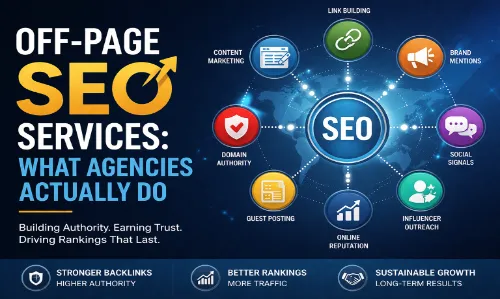
When most business owners hear “SEO services,” they think about keywords, blogs, and title tags on their website, or they skim general guides like this overview of modern SEO services. But a huge part of real‑world SEO success actually happens off the site, through what we call off‑page SEO services. Off‑page SEO (sometimes called off‑site SEO) covers all the actions that happen away from your domain, but still influence your rankings, traffic, and revenue.
In practice, this means building high‑quality backlinks, earning brand mentions, managing reviews, improving local SEO citations, and using digital PR and outreach to grow your authority. A good SEO agency knows that Google is looking for more than just optimized content or even strong on-page SEO services. It is trying to see if the rest of the web also trusts you, talks about you, and links to you.
If you want to go deeper into the technical side, you can pair this with a dedicated guide on technical SEO services and a full SEO audit service to make sure your site is healthy before you scale your off‑page campaigns.
What Is Off-Page SEO, Really?
Off‑page SEO is every optimization activity that happens outside your own website but still aims to improve your visibility on search engines. It complements on‑page SEO and technical SEO and focuses on signals like:
- Backlinks from other websites
- Brand mentions, with and without links
- Online reviews and ratings
- Social media engagement and shares
- Local business citations and directory listings
Search engines look at these signals as “votes of confidence.” The more trustworthy sites that link to you or mention you, the more likely it is that your brand deserves to rank. For a competitive niche, strong off-page SEO services are what separate the websites that just “exist” from the brands that dominate their market.
Many people think off‑page SEO is just “getting links,” often confusing it with narrow link building services. In reality, a proper SEO agency will treat it as a full reputation and authority‑building system that includes content, outreach, relationship‑building, and ongoing monitoring.
If you are new to the bigger picture, it can help to read what SEO clients need to know about how all these moving parts fit together.
Why Off-Page SEO Services Matter for Your Business
If you only work on your own pages and never invest in off‑page SEO, you hit a ceiling very quickly. Here is why these services matter so much:
- Backlinks are still one of the strongest ranking signals, which you can explore further in this breakdown of how backlinks affect domain authority and rankings.
- Brand searches and mentions show that people know and trust your business.
- Reviews and local citations help you show up in maps and local packs when people search “near me,” as covered in guides on local SEO services for small businesses and local citation building.
- Off‑page SEO makes your entire marketing more defensible; competitors can copy your content, but it is much harder to copy years of relationships, mentions, and high‑quality links.
For a deeper contrast of tactics and risk levels, it is worth reviewing white hat vs black hat SEO link building so you understand which approaches support long‑term growth.
The more competitive your city, country, or industry is, the more you need a serious off‑page SEO strategy. For example, an ecommerce brand selling internationally should pair off‑page work with dedicated ecommerce SEO services for online stores, while a multi‑location brand may rely heavily on local SEO ranking factors for multi-location brands.
The Core Pillars of Off-Page SEO Services
Professional SEO agencies usually structure their off‑page services around a few core pillars: authority, relevance, reputation, and local presence.
1. Authority and Backlinks
Most off‑page SEO packages start with link building. But good link building is not about buying random links or spamming blog comments. Instead, agencies focus on:
- Earning backlinks from relevant, authoritative websites
- Using natural, descriptive anchor text
- Getting links to key pages that need ranking power
- Avoiding risky tactics, private blog networks, and obvious link schemes
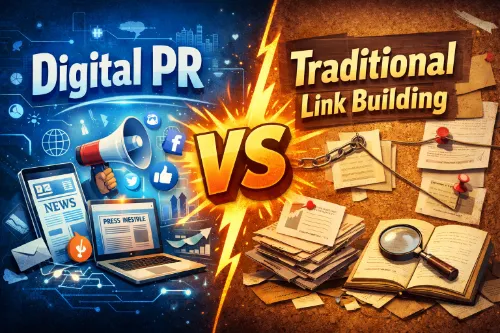
To understand the strategic differences between modern PR‑led tactics and older methods, compare this breakdown of digital PR vs traditional link building. If you want to learn how professionals evaluate opportunities, this guide on how to evaluate the quality of backlinks is a useful next step.
2. Brand Signals and Mentions
Off‑page SEO also includes brand mentions that don’t always come with a link. When your brand name appears in articles, resource lists, and social posts, it sends extra signals that your business is real and recognized.
Agencies work to:
- Get your brand mentioned in relevant blogs, news sites, and industry resources
- Encourage people to search for your brand name plus key services
- Keep your brand information consistent across all channels and directories
If you are running broader content campaigns, it helps to have an underlying content SEO services strategy and a solid plan for SEO content planning for topical authority, so that all those mentions support a clear cluster of topics.
3. Reputation and Reviews
Online reputation is another major part of off‑page SEO, especially for local and YMYL sectors. If you are a local business, your Google Business Profile, industry review platforms, and local directories strongly influence how often you appear and how many clicks you get.
Agencies help you:
- Set up and optimize your Google Business Profile and local listings (often pairing with Google Business Profile optimization services)
- Build a review generation process that encourages happy customers to leave feedback
- Respond to reviews in a professional way, especially negative ones
- Use reviews as social proof on your website and landing pages
For an in‑depth look at how this plays out in the Philippines, see the local SEO audit guide for Philippine businesses and the case study on local SEO success for a Philippine business.
What SEO Agencies Actually Do Day-to-Day for Off-Page SEO
Now let’s break down what happens behind the scenes when you hire an SEO agency for off‑page services. These are the real tasks that take place each week and month.
Off-Page SEO Audit and Strategy
Before placing a single backlink, a good agency runs an off‑page audit. This usually includes:
- Analyzing your current backlink profile (number of links, referring domains, quality, anchor text)
- Identifying toxic links that might cause risk
- Mapping out your top competitors’ backlinks and off‑page assets
- Finding content gaps where competitors have strong linkable assets and you do not
To align off‑page work with your site health, many teams combine this with a broader website SEO audit vs full SEO strategy discussion and review the important sections of an SEO audit report.
From this, they create an off‑page strategy that prioritizes which pages to push, which topics to build authority around, and which types of links and mentions will move the needle fastest. Guides on keyword mapping for service pages and blogs and commercial vs informational keywords often inform these decisions.
Prospecting and Qualifying Link Opportunities
The next big area of work is link prospecting. Agencies:
- Identify websites in your niche or related industries that could logically link to your content
- Check these sites for organic traffic, topical relevance, editorial standards, and spam signals
- Build segmented lists for different campaigns: guest posts, resource pages, unlinked mentions, broken link building, and digital PR
If you want to see how agencies find opportunities, this guide on agencies find low competition high intent keywords shows how keyword research and link prospecting often work together.
Creating Linkable and Shareable Content
You cannot do strong off‑page SEO without content worth linking to. So agencies create or help you create “linkable assets,” such as:
- In‑depth guides, how‑tos, and tutorials
- Original research, statistics, or data roundups
- Tools, calculators, or checklists
- Visual content like infographics that can be embedded and shared
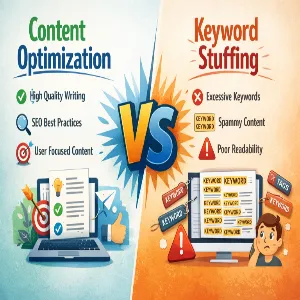
To make sure these assets also perform on your own site, it is smart to follow content optimization vs keyword stuffing best practices and an on-page SEO checklist for service-based websites. Over time, content refresh services for old website pages also help keep your linkable assets up‑to‑date.
Outreach and Relationship Building
One of the biggest parts of off‑page SEO services is outreach. Agencies run campaigns to connect with publishers, bloggers, journalists, and site owners. Common outreach activities include:
- Pitching guest post ideas tailored to each site’s audience
- Suggesting your content as a replacement for broken or outdated links
- Asking to be included in resource pages, list posts, and tool roundups
- Following up on unlinked brand mentions and requesting a link where appropriate
For a clear comparison of DIY outreach vs hiring a team, see the article on DIY SEO vs hiring an SEO agency and the breakdown of SEO consultant vs SEO agency.
Digital PR and Brand Campaigns
Off‑page SEO often overlaps with digital PR. Beyond one‑to‑one outreach, agencies run campaigns designed to get your brand covered in media and high‑authority sites. These might include:
- Data‑driven stories and reports pitched to journalists
- Expert commentary and quotes for articles in your niche
- Collaborations with influencers, podcasters, and YouTube creators
- Participation in journalist request platforms where reporters look for sources
If you want to see how this works from the link side, the comparison of digital PR vs traditional link building and case studies like content-led SEO growth are helpful.
Local Off-Page SEO and Citations
For businesses serving specific areas, local SEO is a critical part of off‑page services. Agencies make sure your business is visible and consistent everywhere people might search locally. Tasks include:
- Creating and optimizing local listings and citations (Google Business Profile, industry directories, local portals)
- Cleaning up inconsistent NAP (name, address, phone) information across the web
- Adding your business to high‑quality local and niche directories, not spammy link farms
- Using local content and outreach to earn links from community websites, local news, and events
You can see how this applies to specific verticals in guides like local SEO helps clinics, law firms and restaurants and local SEO strategies for property listings.
Social, Communities, and Engagement
While most social media links are “nofollow,” social activity still contributes to off‑page SEO. Agencies treat social and communities as distribution channels that can help content earn natural links. They might:
- Promote new content on social platforms and to relevant communities
- Encourage employees or partners to share important pieces
- Engage on forums, Q&A sites, and niche communities in a non‑spammy way
- Support co‑marketing partnerships with complementary brands
Done well, this supports search intent and can be paired with search intent optimization for better rankings.
Risk Management and Link Cleanup
Not all backlinks are good. Over time, a site can attract low‑quality links, spam, or even deliberate negative SEO. Part of off‑page SEO services is monitoring and managing this risk. Agencies:
- Regularly review your backlink profile for suspicious patterns
- Identify spammy or harmful links that could be devalued or cause issues
- Advise when a disavow file might make sense, and when it is not needed
- Educate clients about risky tactics such as buying links in bulk or using private networks
Guides on why rankings dropped even with SEO work and why some SEO campaigns fail often highlight this side of off‑page strategy.
How Agencies Measure Off-Page SEO Success
Serious SEO agencies treat off‑page SEO as a measurable, trackable investment. While rankings and traffic are the ultimate goals, they also watch leading indicators that show whether their work is building momentum. Typical metrics include:
- Number of new referring domains per month
- Quality of new backlinks (authority, relevance, traffic)
- Growth in brand mentions and branded search volume
- Increase in reviews and average ratings
- Improvements in local pack visibility and map rankings
Alongside these, they track organic rankings, clicks, conversions, and revenue. To connect the dots between metrics, reporting, and business impact, see the resources on how to measure SEO ROI for your business, SEO KPIs every business owner should track, and SEO reporting metrics clients actually care about.
Red Flags to Watch for in Off-Page SEO Offers
Because off‑page SEO and link building take time, some providers try to shortcut the process with tactics that may hurt you later. Watch out for these red flags:
- Guaranteed numbers of backlinks or rankings in a fixed timeframe
- Very low‑cost packages that promise hundreds of links per month
- No transparency about which websites they will target
- Heavy reliance on private blog networks or obvious “SEO blogs” with no real audience
- No mention of content, outreach, or relationship‑building
To protect yourself, review the guides on red flags to watch for in SEO companies, guaranteed SEO services, and what SEO services can and cannot guarantee.
What a Typical Off-Page SEO Engagement Looks Like
If you sign up for a proper off‑page SEO service, you can expect a structure like this.
- Month 1–2: Strategy and Foundations
- Full audit of current backlinks, mentions, and citations
- Competitor benchmark and gap analysis
- Cleanup of critical issues and toxic links
- Planning linkable assets and outreach campaigns
- Month 3–6: Active Link Building and PR
- Launching guest posting and outreach campaigns
- Publishing linkable assets and promoting them
- Running local SEO and citation campaigns if relevant
- Beginning to see upward movement in rankings and traffic
- Month 6+: Scaling, Refinement, and Defense
- Expanding to new markets, regions, or product lines
- Deepening relationships with publishers and partners
- Ongoing monitoring and risk management
- Using off‑page SEO data to inform content and on‑page work
Off‑page SEO is not a one‑time task. It is a continuous process of building your brand’s authority across the web, which is why many businesses prefer ongoing monthly SEO services vs one-time SEO projects instead of one‑off fixes.
How to Choose the Right Off-Page SEO Agency
When evaluating agencies, focus less on flashy promises and more on process and transparency. Good questions to ask include:
- How do you research and qualify sites before pursuing a link?
- What types of content and outreach campaigns do you run?
- Can you show examples of real placements and the context around them?
- How do you handle local SEO, reviews, and citations if I serve a specific area?
- How will you report on the links and mentions you earn each month?
Resources like how to compare SEO proposals from different agencies, how to choose the right SEO agency, and questions to ask before hiring SEO services will help you evaluate partners more confidently.
By understanding what off‑page SEO services actually involve—and by using the guides above to explore technical SEO, audits, content, local visibility, and pricing—you can build a more complete, long‑term strategy instead of chasing short‑lived tricks.
Frequently Asked Questions
How is off-page SEO different from digital PR?
Off-page SEO focuses on improving rankings with external signals like backlinks and citations, while digital PR focuses on broader media coverage and brand visibility—but the two often overlap and support each other.
Can off-page SEO work if my on-page SEO is weak?
Off-page SEO will have limited impact if your site has serious on-page or technical issues, so agencies usually recommend fixing basics first with on-page and technical SEO work and an initial audit.
How long does it take to see results from off-page SEO only?
Most businesses start seeing clearer off-page gains—more referring domains, stronger positions, and incremental traffic—within 3–6 months, but competitive niches and new sites may take longer.
Is it safe to buy backlinks for faster off-page results?
Buying links that violate search guidelines is risky and can lead to penalties; sustainable off-page SEO relies on earning or carefully negotiated placements on relevant, real sites.
How many backlinks do I need to rank on page one?
There is no fixed number; the “right” backlink count depends on the strength of competing pages, the quality of your links, and the topical relevance of those linking domains.
Do social media likes and shares help my off-page SEO?
Social signals are not direct ranking factors, but they amplify your content, increase brand awareness, and can indirectly lead to natural backlinks and mentions.
Should I prioritize domain authority or relevance when building links?
Relevance is critical; high-quality off-page SEO prioritizes links from thematically related sites with real traffic, using metrics like authority as supporting data rather than the main goal.
Can off-page SEO help a completely new domain?
Yes, early off-page work (foundational citations, initial backlinks, and some PR) helps new domains build trust and index faster, but results typically grow gradually over time.
What tools do agencies use to manage off-page SEO campaigns?
Agencies commonly use SEO suites for backlink analysis, outreach CRMs or email tools for campaigns, and monitoring tools for brand mentions, reviews, and rankings.
Is guest posting still a safe off-page SEO strategy?
Guest posting remains effective when done on relevant, real sites with useful content and natural anchors, but scaled, low-quality guest blogging networks are considered risky.
How does influencer marketing fit into off-page SEO?
Collaborations with influencers can generate brand mentions, referral traffic, and backlinks from blogs, YouTube, and social profiles, supporting both visibility and authority.
Can off-page SEO improve local map pack rankings?
Yes, local citations, reviews, and locally relevant backlinks strengthen local signals and often help businesses appear more frequently in Google’s local map results.
What are the most common off-page SEO mistakes businesses make?
Typical mistakes include chasing quantity over quality, using spammy directories, over-optimizing anchor text, ignoring reputation and reviews, and not monitoring their backlink profile.
How often should my backlink profile be audited?
Most businesses benefit from a light review monthly and a deeper off-page audit every 6–12 months, or after major campaigns and algorithm updates.
Does press release distribution still help with off-page SEO?
Mass, low-quality press release syndication offers little value today; selective, newsworthy releases to real publications can still help when part of a broader digital PR strategy.
Can off-page SEO fix a drop in rankings after an algorithm update?
Off-page work can help recover authority over time, but you should first diagnose whether the drop is due to content, technical issues, or link quality before adjusting your strategy.
How do agencies decide which pages to build links to?
They usually prioritize pages with clear business value (service, product, or key informational assets) and pages that are close to ranking strongly but need extra authority.
Is it better to build links to my homepage or inner pages?
A natural profile includes both, but for SEO performance, agencies often focus more on relevant inner pages while still maintaining some branded links to the homepage.
Can off-page SEO be paused without losing all gains?
You keep many benefits, but if off-page work stops for a long time while competitors continue, your relative authority can slip and rankings may gradually decline.
How do I know if my off-page SEO agency is doing quality work?
Look for transparent reporting of actual placements, relevance of linking sites, steady growth in quality referring domains, and measurable improvements in visibility and leads—not just raw link counts.