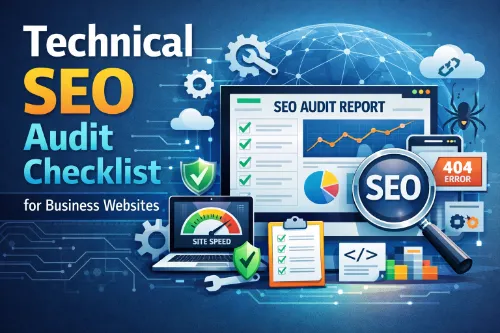
Technical SEO services cover all the behind‑the‑scenes fixes that help search engines and AI systems crawl, understand, and rank your website reliably, forming the backbone of your broader SEO services. When you get technical SEO right, your content, links, and local or eCommerce strategies can finally reach their full organic potential in both classic search and AI Overviews.
Technical SEO services include comprehensive technical SEO audits, site architecture improvements, crawlability and indexation fixes, Core Web Vitals optimization, mobile‑friendliness, HTTPS security, structured data, and ongoing monitoring to keep your site fast, stable, and easy to understand for both search engines and AI assistants. These services matter because they directly influence crawlability, indexation, rankings, AI Overviews, user experience, conversions, and how effectively your brand shows up across GEO‑specific and industry‑specific searches.
What Technical SEO Services Include
Technical SEO focuses on your website’s infrastructure: how pages load, how bots crawl, how content is rendered, and how data is structured. Instead of tweaking just keywords or content ideas, technical SEO services work on the code, templates, and configuration that power your site, often in tandem with dedicated technical SEO services packages.
1. Comprehensive Technical SEO Audit
Most engagements start with a full technical SEO audit. This structured health check surfaces what’s broken, what’s blocking crawlability, and what’s holding back rankings, AI visibility, and even local SEO or eCommerce performance. If you want a deeper breakdown of what this process looks like, see this guide on technical SEO audit.
A typical technical SEO audit includes:
- Full site crawl (all URLs, status codes, canonical tags, redirects, indexation state) and identification of technical SEO issues.
- Detection of duplicate content, thin pages, orphan pages, and redirect chains.
- Checks on robots.txt, XML sitemaps, hreflang (if applicable), and canonicalization.
- Core Web Vitals test (LCP, CLS, INP/FID) plus page speed performance.
- Mobile‑friendliness and responsive design review.
- HTTPS implementation, SSL issues, and mixed‑content checks.
If you also run content or keyword strategy, pairing this with broader SEO audit services will help you connect technical issues with content opportunities.
2. Site Architecture and URL Structure
Site architecture is how your content is organized and connected. Strong architecture makes it easier for search engines and AI agents to infer relationships, understand entities, and allocate crawl budget efficiently.
Key elements include:
- Logical hierarchy: Home → category → subcategory → detailed page, with solid internal linking that supports your topical clusters (see how internal linking improves rankings).
- Shallow click depth so important pages are reachable in three clicks or fewer.
- Clean, human‑readable URLs that reflect topics, not unnecessary tracking parameters.
- Canonical tags to signal the preferred version of similar URLs.
- Contextual links that support on‑page SEO basics and your broader content strategy.
For service businesses, combining technical architecture work with an on‑page SEO checklist for service‑based websites helps you scale this structure across all key pages.
3. Crawlability and Indexation
If search engines and AI crawlers can’t reach or index your pages, they effectively don’t exist. Technical SEO services put a lot of focus here because crawlability and indexation are prerequisites for rankings, AI Overviews, and any GEO or local visibility.
Core tasks include:
- Robots.txt optimization so you don’t accidentally block important URLs while still excluding low‑value or sensitive areas.
- XML sitemap creation and maintenance for key sections (blog, products, locations).
- Proper use of noindex, follow, and other meta directives.
- Fixing 4xx and 5xx errors, redirect loops, and “soft 404s.”
- Handling faceted navigation and URL parameters so they do not waste crawl budget, which becomes critical on large and enterprise websites.
For multi‑location brands, pairing crawlability work with local SEO services for small businesses or local SEO ranking factors for multi‑location brands ensures all priority locations are discoverable.
4. Page Speed and Core Web Vitals
Page speed and Core Web Vitals are central ranking and experience signals that also influence whether AI systems consider your site “answer‑worthy” when summarizing results. To understand the impact, you can review how page speed impacts SEO performance and why Core Web Vitals for SEO matter.
Technical SEO services usually work on:
- Optimizing LCP by reducing server response time, optimizing hero images, and cleaning up render‑blocking resources.
- Reducing CLS by reserving space for images, ads, and embeds.
- Improving interaction metrics like INP by splitting heavy scripts, deferring non‑critical JS, and cleaning up third‑party tags.
- Implementing caching, compression, and a content delivery network (CDN).
These improvements make a site feel instantly faster on desktop and mobile and support your on‑page SEO services by giving your content a better technical environment.
5. Mobile‑Friendliness and Responsive Design
With mobile‑first indexing and a mobile‑dominant user base, technical SEO must ensure your site behaves smoothly on phones and tablets.
This work usually covers:
- Ensuring responsive design is implemented correctly, with consistent content across devices.
- Fixing mobile usability issues like touch targets, font sizes, and horizontal scrolling.
- Verifying that mobile pages load quickly even on slower connections.
- Matching mobile and desktop structured data so AI Overviews and local panels display consistent information.
If you serve local audiences, pairing this with Google Business Profile optimization services and local citation building makes you much easier to find on mobile.
6. HTTPS, Security, and Stability
Security and stability are technical SEO factors too. Search engines and AI assistants prefer to send users to sites that are safe, stable, and trustworthy.
Technical SEO services typically:
- Enforce HTTPS site‑wide and clean up mixed‑content issues.
- Standardize redirects (HTTP → HTTPS, non‑www → www or vice versa).
- Configure HSTS where appropriate and maintain SSL certificates.
- Monitor uptime and server responses to avoid intermittent 5xx errors.
If you’re working with sensitive verticals like medical websites or law firms, this also supports E‑E‑A‑T and user trust.
7. Structured Data and Schema Markup
Structured data (schema markup) helps search engines, AI Overviews, and other search features understand the entities on your site: organizations, people, products, services, FAQs, locations, and more.
Common implementations include:
- Organization and LocalBusiness schema for brand and GEO presence, especially when tied to local SEO audits for Philippine businesses or other regions.
- Product and Offer schema for eCommerce sites alongside eCommerce SEO services for online stores.
- Article and BlogPosting schema to support your content SEO services.
- FAQPage and HowTo schema to earn rich results and AI Overview citations.
Schema markup also works best when the underlying content is well‑planned using SEO content planning for topical authority and blog clusters that support SEO service pages.
8. On‑Page Technical Elements
On‑page SEO and technical SEO overlap in key areas that your CMS can scale automatically.
Typical tasks:
- Enforcing unique, descriptive title tags that surface the main keyword early and reflect on‑page SEO basics.
- Writing meta descriptions that summarize the page in simple, AI‑friendly language without keyword stuffing.
- Ensuring one clear H1 per page with logical H2/H3 subheadings.
- Optimizing images (file names, alt text, modern formats like WebP).
- Cleaning up code bloat, duplicate scripts, and unnecessary plugins, while keeping landing pages optimized for search engines.
Combining this with on‑page SEO services gives you a full funnel of technical plus content optimization.
9. Advanced Diagnostics and Enterprise‑Level Technical SEO
On enterprise or very large sites, technical SEO services may include advanced work that ties directly into enterprise SEO services for large websites.
This can involve:
- Log‑file analysis to see exactly which URLs bots crawl most often, crucial when you’re managing SEO for thousands of pages.
- Identifying crawl traps, infinite spaces, parameter combinations, and other enterprise technical SEO challenges and solutions.
- Implementing governance and workflows using SEO governance for large organizations and automation opportunities in enterprise SEO.
For global brands, this also connects with how enterprise SEO supports global brands.
10. Ongoing Monitoring and Maintenance
Technical SEO is not a one‑time project. Code changes, content updates, migrations, and platform upgrades constantly introduce new risks.
Ongoing services usually include:
- Regular crawls to catch new errors and important sections of an SEO audit report.
- Monitoring Core Web Vitals and performance trends.
- Keeping sitemaps and schema markup up to date.
- Adjusting implementation as Google, Bing, and AI systems evolve, and using insights from SEO reporting metrics clients actually care about.
To keep strategy aligned, business owners can also learn what to do after an SEO audit and how often they should get an SEO audit.
Why Technical SEO Services Matter Now
Technical SEO has always mattered, but in the age of AI Overviews, entity‑based search, and more sophisticated ranking systems, it is essential for sustainable growth.
1. Foundation for All SEO and AEO
No matter how good your content and link‑building are, they will underperform without a healthy technical base. If pages are slow, blocked, or confusing to crawlers, search engines and AI assistants may skip or down‑rank them.
Technical SEO ensures:
- Your most important URLs are discoverable and indexable.
- Your content is machine‑readable and entity‑rich, supporting search intent optimization for better rankings.
- Your site qualifies for rich results, featured snippets, and AI Overviews.
This also multiplies the impact of off‑page work like link building services and digital PR vs traditional link building.
2. Better Rankings and Organic Visibility
Technical SEO enhances every ranking factor you already invest in. Improved crawlability and indexation often uncover “hidden” potential: pages that suddenly start ranking once they’re properly exposed and understood.
When you fix core technical SEO issues:
- Rankings become more stable and predictable.
- New content gets indexed faster and with fewer errors.
- Your site sends clearer signals about topical authority and entity relationships, especially when combined with keyword research services for lead generation and keyword mapping.
This is true for local brands, eCommerce stores, and industry‑specific campaigns like SEO services for law firms or real estate agencies.
3. Improved User Experience and Conversions
Search engines increasingly use user experience as a proxy for quality. Fast, reliable, mobile‑friendly sites typically deliver better engagement, which feeds back into SEO performance.
Technical SEO improvements often lead to:
- Lower bounce rates from faster load times and fewer errors.
- Longer session duration thanks to clean navigation, strong internal linking, and well‑structured content SEO services.
- Higher conversion rates from smoother checkout or lead forms, particularly on product pages and service landing pages.
Case studies like SEO wins from technical fixes alone and how a service business increased leads organically show how powerful this can be.
4. Risk Reduction and Future‑Proofing
Technical errors can tank traffic overnight: broken redirects in a migration, misconfigured robots.txt, or a server slowdown.
Technical SEO services help you avoid these scenarios by:
- Making site migrations safer, especially on platforms like Shopify, WooCommerce, and Magento where technical SEO for eCommerce platforms is critical.
- Catching indexation drops or performance regressions early.
- Preparing you for new ranking signals and AI‑driven features with help from SEO in 2026 insights.
This protects your investment in content and brand and supports long‑term growth, reinforcing why SEO is a long‑term investment.
5. Competitive Advantage in Your GEO and Industry
If you operate in specific locations or verticals, solid technical SEO helps you compete locally and globally.
Examples:
- Local businesses benefit from local SEO helps clinics, law firms and restaurants and local SEO success stories for Philippine businesses.
- eCommerce brands rely on category page SEO best practices and avoiding common eCommerce SEO mistakes that kill conversions.
- SaaS and B2B teams lean on SaaS SEO services for long sales cycles and product‑led SEO strategies.
In markets where competitors still ignore technical SEO, a well‑optimized site can leap ahead simply by being more accessible and understandable to search engines and AI.
Core Technical SEO Services
- Full technical SEO audit and site health check.
- Site architecture and URL structure optimization backed by strong internal linking.
- Crawlability, robots.txt, and XML sitemap management.
- Indexation control and duplicate content prevention across blogs, service pages, and eCommerce SEO services.
- Page speed and Core Web Vitals optimization.
- Mobile‑friendliness and responsive design fixes, especially for local SEO services.
- HTTPS implementation and security hardening.
- Structured data and schema markup implementation to support AI Overviews and rich results.
- On‑page technical improvements that align with your on‑page SEO services.
- Advanced diagnostics, log‑file analysis, and governance for enterprise SEO.
- Ongoing monitoring, SEO KPIs tracking, and reporting.
DIY vs Hiring a Technical SEO Specialist
You can handle some basics in‑house—simple speed wins, minor content clean‑up, or fixing obvious broken links—especially with resources like DIY SEO vs hiring an SEO agency. But deeper technical SEO services require development skills, SEO strategy, and a solid understanding of how search engines and AI systems behave.
You should consider hiring a specialist or agency when:
- You’re planning a redesign or platform migration.
- You have hundreds or thousands of URLs or complex eCommerce architecture.
- You rely heavily on organic traffic for leads or revenue and want to understand how long SEO services take to work.
- You want to be visible in AI Overviews and answer engines, not just traditional listings.
Resources like SEO consultant vs SEO agency, how to choose the right SEO agency, and questions to ask before hiring SEO services can help you decide.
Frequently Asked Questions
1. How is technical SEO different from on‑page SEO?
Technical SEO focuses on your site’s infrastructure (crawlability, speed, code, security), while on‑page SEO focuses on optimizing visible content, keywords, and UX on each page. Both work together: technical SEO makes your pages accessible, and on‑page SEO makes them relevant.
2. Do I need technical SEO if my site is small?
Yes. Even small sites can suffer from slow loading, indexation issues, or poor mobile usability that hurt rankings and conversions. A lean site still needs a clean technical foundation so search engines and AI systems can understand it easily.
3. How often should I perform a technical SEO audit?
Most sites benefit from a technical SEO audit at least once or twice per year, plus after major redesigns or migrations. High‑traffic or fast‑changing sites may need quarterly checks to catch issues before they impact revenue.
4. Can technical SEO fix a sudden drop in rankings?
Technical SEO can often identify and fix issues like crawl errors, broken redirects, indexation problems, or Core Web Vitals regressions that cause drops. However, algorithm updates, content quality, or backlinks can also be factors, so you usually need a holistic review.
5. Is technical SEO still important with AI Overviews and answer engines?
Yes. AI Overviews tend to favor fast, stable, technically sound pages with clear structure and strong signals of authority. If your technical setup is weak, AI systems may skip your pages in favor of better‑optimized alternatives.
6. How long does it take to see results from technical SEO fixes?
Many technical fixes (like removing blocks to crawling or indexation) can deliver visible improvements in a few weeks once recrawled. Larger projects, such as site architecture changes or platform migrations, can take several months to fully pay off.
7. Do I need a developer to implement technical SEO recommendations?
For most sites, yes—technical SEO often involves templates, scripts, server settings, and CMS configuration that require development access. A good workflow pairs an SEO specialist with a developer to implement changes safely and accurately.
8. What tools are commonly used for technical SEO?
Common tools include crawling software, page speed testers, Core Web Vitals reports, log analyzers, and search console platforms. Many teams combine multiple tools to cross‑check findings and prioritize the most impactful issues.
9. Can technical SEO alone rank my site without content or links?
No. Technical SEO is the foundation, not the whole building. You still need quality content and relevant backlinks; technical work simply makes it easier for search engines to discover, understand, and trust that content.
10. How does technical SEO support local SEO?
Technical SEO ensures your local pages are crawlable, indexable, fast, and mobile‑friendly, which is critical for local queries and map‑related results. It also supports clean structured data for addresses, opening hours, and multi‑location setups.
11. What technical SEO issues hurt Core Web Vitals the most?
Common problems include unoptimized images, render‑blocking JavaScript and CSS, slow servers, and layout shifts caused by ads or late‑loading elements. Fixing these can significantly improve LCP, CLS, and interaction metrics.
12. How does structured data help technical SEO?
Structured data gives search engines explicit information about entities (people, products, organizations, events), making your pages easier to classify and eligible for rich results. This clarity is increasingly valuable for AI‑driven features and answer boxes.
13. Is technical SEO a one‑time project?
No. New content, plugins, design changes, and platform updates constantly introduce technical risk. You need ongoing monitoring and periodic audits to keep your technical foundation healthy over time.
14. What is crawl budget and when should I worry about it?
Crawl budget is the number of URLs a search engine is willing to crawl on your site over a given period. It matters most for large or frequently updated sites, where technical SEO helps direct bots toward your highest‑value pages.
15. Can bad technical SEO affect analytics and tracking?
Yes. Misconfigured redirects, duplicate URLs, and inconsistent tracking scripts can fragment data and make performance harder to measure accurately. Fixing these technical issues leads to cleaner reporting and better decisions.
16. How does technical SEO help with site migrations or replatforming?
Technical SEO guides URL mapping, redirects, canonical rules, and launch checks so you preserve rankings and traffic during a move. Without it, migrations often lead to indexation loss, broken links, and major drops in visibility.
17. Does every CMS need the same technical SEO work?
No. Each CMS (WordPress, Shopify, custom builds, etc.) has its own technical quirks, default structures, and plugin ecosystems. A good technical SEO plan adapts to your stack while following universal best practices.
18. How important is log‑file analysis for technical SEO?
Log‑file analysis is crucial for large or complex sites because it shows how bots actually crawl your pages, not just how tools simulate them. It helps you spot crawl waste, traps, and missed high‑value URLs with real‑world data.
19. Can technical SEO improve conversion rates, not just traffic?
Indirectly, yes. Faster, more stable, mobile‑friendly pages with fewer errors create smoother journeys, which usually increases conversions. Technical fixes reduce friction at every step of the funnel.
20. How do I prioritize technical SEO issues when everything looks important?
Start with fixes that restore access (crawlability, indexation, major errors), then move to performance and UX, and finally refinements like advanced schema. A well‑structured technical audit should rank tasks by impact and effort so you focus on what moves the needle first.