

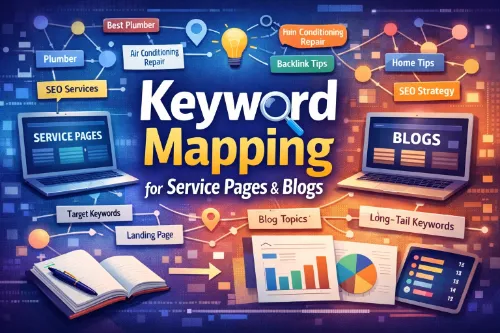
Keyword mapping is the process of assigning the right keywords to the right pages so your site can rank higher, avoid cannibalization, and give users exactly what they are searching for. It aligns service pages with commercial or transactional search intent and blog posts with informational queries, while building clear topic clusters and internal links.
In this guide, you’ll learn what keyword mapping is, how to build a keyword map for service pages and blogs, how to use it for site structure, internal linking, and content optimization, and how to keep it updated as your SEO strategy grows.
What Is Keyword Mapping (In Simple Terms)?
Keyword mapping is assigning specific keywords or keyword clusters to individual URLs on your website. Instead of targeting the same phrase on many pages, you give each page a clear focus so search engines and AI models know which page to show for which query.
In practice, a keyword map is usually a spreadsheet where you list your pages, target keywords, search intent, and basic SEO notes such as title tags, meta descriptions, and internal linking opportunities. This helps you avoid keyword stuffing and plan content that follows best practices for content optimization vs. keyword stuffing.
When you connect keyword mapping with strategic resources like SEO services and content SEO services: strategy, writing, and optimization, the result is a clear, scalable framework for long‑term organic growth.
Why Keyword Mapping Matters for Service Pages and Blogs
Service pages and blog posts play different roles in SEO, but they should support each other inside one unified keyword map.
For service pages
- They are your money pages, focused on leads and sales, so they should target commercial and transactional keywords like “SEO agency in [City]” or “roof repair services near me.” You can see how this is implemented in practice in guides on on‑page SEO services and off‑page SEO services.
- Mapping primary and secondary keywords to each service page helps you align your offers with user intent and avoid competing pages for the same term, especially when you also use a solid on‑page SEO checklist for service‑based websites.
For blog posts
- Blogs are better for informational and educational intent, such as “what is keyword mapping,” “how to plan a content strategy,” or “keyword mapping examples.” Articles like SEO content planning for topical authority and how blog clusters support SEO service pages are strong examples of this approach.
- When you map keyword clusters to blogs, you can cover long‑tail and question‑based queries, then link back to your service pages as pillar or solution pages. For example, a guide on keyword mapping for service pages and blogs is a natural hub for many related queries.
By combining both, keyword mapping becomes your roadmap for site architecture, internal linking, and AI‑friendly topical authority.
Step‑By‑Step: How to Do Keyword Mapping
1. Start with keyword research
Begin by collecting a list of relevant keywords around your main services and topics. You can look at examples from keyword research services for lead generation and ecommerce keyword research for buyer intent to see how commercial and informational terms get separated.
At this stage, your goal is breadth:
- Primary keywords with good search volume and realistic difficulty.
- Supporting long‑tail queries, questions, and related semantic phrases. Guides such as agencies find low‑competition high‑intent keywords are helpful here.
- Geo‑specific variations like “[service] in [City/Region]” if you target local SEO, similar to local SEO services for small businesses.
2. Understand search intent behind each keyword
Next, classify each keyword by search intent: informational, commercial, transactional, or navigational.
- Informational: “what is keyword mapping,” “how to map keywords,” or “commercial vs informational keywords.” For more detail, see commercial vs informational keywords in SEO campaigns.
- Commercial: “best keyword mapping tools,” “SEO consultant vs SEO agency,” or “affordable SEO services.” You can explore SEO consultant vs SEO agency and affordable SEO services for small business owners.
- Transactional: “hire SEO consultant,” “SEO services in [City],” or “SEO audit services.” Related references include hire an SEO consultant and SEO audit services.
Search intent tells you whether a keyword should belong to a service page, pillar page, or blog post and connects directly to search intent optimization for better rankings.
3. Group keywords into topical clusters
Once you know the intent, group related keywords into clusters based on shared topics and similar SERP results.
For example, a “keyword mapping” cluster might include:
- keyword mapping
- keyword mapping for SEO
- keyword mapping for service pages
- keyword mapping for blogs
- keyword mapping template
- keyword mapping strategy
- how to create a keyword map
This kind of organization is similar to the way commercial intent clusters and industry‑specific clusters are structured. Each cluster represents one main topic with multiple variations and semantically related phrases, which is important for NLP‑friendly content.
4. Assign clusters to URLs (service vs blog)
Now you match each keyword cluster to the best URL or to a new page you will create.
- If the cluster is transactional or commercial, assign it to a service page or landing page, such as one oriented around SEO services or local SEO services for small businesses.
- If the cluster is informational, assign it to a blog post, guide, or FAQ resource, similar to how blog clusters support SEO service pages.
Each page should have one primary keyword and several secondary keywords from the same cluster. This is especially important when you design campaigns such as enterprise SEO services for large websites or ecommerce SEO services for online stores.
5. Build your keyword mapping sheet
Set up your keyword map in a spreadsheet with columns such as:
- URL (existing or planned)
- Page type (service page, blog, category, homepage)
- Primary keyword
- Secondary keywords / semantic keywords
- Search intent
- Target location (for GEO)
- Meta title concept and meta description note
- H1/H2 ideas
- Internal link opportunities
- Action (create, optimize, no action)
This structure keeps everything organized and also makes it easier to layer in other resources, like on‑page SEO basics, technical SEO services, and link building services, as part of your wider plan.
How to Map Keywords for Service Pages
Key principles
- One main service per URL with a clear primary keyword.
- 3–5 strong secondary keywords that are close variations or semantic relatives.
- Strong alignment between keyword, service offering, and user intent.
You can see this approach in action in resources like local SEO services for small businesses, SEO services for law firms, or SaaS SEO services for long sales cycles.
Example setup for a service page
If you offer SEO, a cluster might look like:
- Primary: “SEO services in [City]”
- Secondaries: “affordable SEO services,” “best SEO agency traits,” “monthly SEO services,” “SEO audit services”
You can model your copy using insights from:
- best SEO agency traits for long‑term growth
- monthly SEO services vs one‑time SEO projects
- how much do SEO services cost?
On‑page optimization using the keyword map
Use your keyword map to guide on‑page SEO and connect to deeper guides where relevant:
- Meta and copy: follow optimize landing pages for search engines and on‑page SEO basics.
- Technical: reference technical SEO audit and technical SEO issues.
- Performance: incorporate tips from page speed impacts SEO performance and core web vitals for SEO.
How to Map Keywords for Blog Posts
Principles
- Each blog post targets one main informational topic.
- Long‑tail variations and questions become H2s and H3s.
- The content links back to relevant service pages as the solution or next step.
For instance, a blog on how blog clusters support SEO service pages can support a main SEO services page, while content refresh services for old website pages protects the performance of that cluster over time.
Example: blog cluster for “keyword mapping”
A blog article might target:
- Primary: “keyword mapping for service pages and blogs”
- Support: “commercial vs informational keywords,” “long‑tail keywords for SEO services businesses,” “SEO content planning for topical authority”
You can connect these to supporting articles such as:
- long‑tail keywords for SEO services businesses
- SEO content planning for topical authority
- how blog clusters support SEO service pages
Benefits of Keyword Mapping for Service Pages and Blogs
- Clearer site structure that pairs well with internal linking improves rankings.
- Better alignment with search intent, as explained in search intent optimization for better rankings.
- Less keyword cannibalization and clearer service vs blog roles.
- Stronger topic clusters supported by industry‑specific clusters.
- Higher chances to rank for long‑tail queries, like those covered in long‑tail keywords for SEO services businesses.
- More focused on‑page optimization guided by on‑page SEO basics and on‑page SEO checklist for service‑based websites.
- Better UX, supported by performance work from technical SEO services and page speed impacts SEO performance.
- Easier content planning anchored by SEO content planning for topical authority.
- Improved AI‑overview visibility through precise clusters and guides like keyword mapping for service pages and blogs.
- A scalable framework you can connect to audits, as seen in website SEO audit vs full SEO strategy.
How Keyword Mapping Supports GEO and Local SEO
For local SEO, keyword mapping clarifies which pages should rank in which locations.
- Service clusters can be tied to local SEO services for small businesses, local SEO helps clinics, law firms and restaurants, or local SEO strategies for property listings.
- Supporting content might cover local citation building, local SEO ranking factors for multi‑location brands, or local SEO audit guide.
- For proof of concept, you can point to case studies such as local SEO success story for a Philippine business.
When this is combined with Google Business Profile optimization services, your keyword map becomes the foundation of a full local SEO ecosystem.
How Keyword Mapping Helps AEO and NLP
Answer Engine Optimization and NLP‑friendly content rely on clarity and complete coverage. Keyword mapping ensures:
- Each topic cluster has a clear hub page, such as SEO services for medical websites backed by medical content SEO and E‑E‑A‑T best practices.
- BOFU and TOFU content are planned in advance, similar to the structure in BOFU vs TOFU content in SaaS SEO.
- There is a clear flow for searchers from education to action, as seen in are SEO services worth it for small businesses? and why SEO is a long‑term investment.
This structure feeds both traditional SERPs and newer AI presentation layers.
Internal Linking with Your Keyword Map
Keyword mapping also guides your internal linking strategy.
- Use guides like internal linking improves rankings to plan how blogs support service pages.
- Build authority to specific service lines, such as enterprise SEO services for large websites, with supporting content about managing SEO for thousands of pages, enterprise technical SEO challenges and solutions, and SEO governance for large organizations.
- Link to success stories like content‑led SEO growth case study and SEO wins from technical fixes alone for social proof and topical depth.
Maintaining and Updating Your Keyword Map
SEO is ongoing, so your keyword map should evolve.
- Revisit clusters after each SEO audit and align with important sections of an SEO audit report and what to do after an SEO audit.
- Review performance and SEO KPIs using how to measure SEO ROI for your business and SEO KPIs every business owner should track.
- Communicate results using SEO reporting metrics clients actually care about and clarify expectations with what SEO services can and cannot guarantee.
By treating your keyword map as a living document, you can adapt quickly when rankings drop, using insights from why rankings dropped even with SEO work and why some SEO campaigns fail.
Frequently Asked Questions
1. How often should I update my keyword map?
You should review and update your keyword map at least once per quarter, or whenever you launch new services, add many new pages, or see major ranking shifts. Regular updates keep your mapping aligned with real search demand and performance data.
2. Do I need a separate keyword map for each language?
Yes. Each language should have its own keyword map because search behavior, phrases, and intent can change across markets. This also helps you manage hreflang, local nuances, and content gaps more efficiently.
3. Can I map multiple keywords with different intents to one page?
You usually should not map clearly different intents (like “what is X” vs “X services”) to the same URL. It is better to create separate pages so each one can fully satisfy the specific intent and rank more consistently.
4. What happens if two pages share the same primary keyword?
If two pages share the same primary keyword, they may compete in the SERPs and cause keyword cannibalization. To fix this, consolidate them, change the target keywords, or reframe one page to serve a different intent.
5. Should I map brand keywords separately from generic keywords?
Yes. Brand keywords deserve their own small cluster, usually mapped to the homepage, about page, and key brand assets. Generic keywords should be mapped to specific service pages, category pages, or blogs focused on broader topics.
6. How detailed should my keyword clusters be?
Your clusters should be detailed enough to cover the main topic and its core variations but not so large that the page becomes unfocused. A practical rule is one main topic with a handful of tightly related subtopics and long‑tails.
7. Do I need keyword mapping if I already rank well?
Yes, because ranking well today does not guarantee you will keep those positions. A keyword map helps you prevent cannibalization, plan new content strategically, and defend existing rankings as competition and algorithms evolve.
8. Can I use keyword mapping for paid search campaigns too?
You can. Many teams use the keyword map as a shared reference for both SEO and PPC, ensuring landing pages, ad groups, and organic content all target consistent keyword themes and messaging.
9. How does keyword mapping help with content briefs?
A keyword map gives content writers clear guidance on primary keywords, secondary terms, search intent, and internal links for each URL. This reduces guesswork and keeps content outlines consistent, even across large teams.
10. Is it okay to adjust mapped keywords after publishing a page?
Yes. It is common to refine mapped keywords after you gather data from search console, analytics, and third‑party tools. You can adjust the primary keyword, add new secondaries, or narrow the topic based on what is actually gaining traction.
11. Should every page on my site have a mapped keyword?
Ideally, yes. Most indexable pages should have a clear target keyword or keyword cluster. Utility pages, thank‑you pages, or other non‑SEO URLs can be excluded, but all SEO‑relevant pages benefit from explicit mapping.
12. How big should a keyword map be for a small business website?
For a small service site, a keyword map might start with 20–100 rows, covering core services, supporting blogs, and key local pages. The size grows naturally as you add more content and expand into new topics.
13. What tools can help me maintain a large keyword map?
You can maintain a large keyword map using spreadsheets, project management tools, or database‑style platforms. The key is to have consistent columns, clear naming conventions, and a versioning process, regardless of the tool you choose.
14. How do I prioritize which mapped pages to optimize first?
Prioritize pages that target high‑value keywords, have good impressions but low CTR, or rank just off page one. You can then work down to lower‑priority clusters as you see results and bandwidth allows.
15. Can keyword mapping improve my featured snippet chances?
Yes. When your keyword map includes question‑style queries and you design content to answer them clearly, you increase your chances of winning featured snippets, “People Also Ask” boxes, and AI‑driven overviews.
16. What is the difference between topic clusters and keyword clusters?
Keyword clusters group related phrases used in search, while topic clusters group pieces of content around a central subject. Your keyword clusters usually feed into topic clusters by telling you what each page within the topic should focus on.
17. How does keyword mapping support E‑E‑A‑T?
Keyword mapping helps you organize content so each topic is treated in depth on focused pages, supported by related assets, case studies, and guides. This structure makes it easier to demonstrate expertise, experience, and trustworthiness around your main services.
18. Is it okay to have informational content on a service page?
It is fine to include helpful informational sections on a service page, such as brief explanations or FAQs, as long as the main focus stays commercial or transactional. Deep educational content is usually better placed on separate blog posts linked from that page.
19. How do I handle outdated topics in my keyword map?
For outdated topics, you can: remove the row if it is no longer relevant, redirect the page to a newer resource, or refresh the content to match current trends and queries. Always update the map to reflect whatever action you take.
20. Can I use the same keyword map structure across different niches?
Yes. The structure of a keyword map—URL, page type, primary and secondary keywords, intent, and notes—works across almost any niche. You only need to change the actual keywords and examples to match the specific industry and audience.







