quick SEO fixes Key Takeaways
Implementing a series of targeted quick SEO fixes can deliver measurable improvements in search visibility within days.
- Identify and fix duplicate title tags and meta descriptions across your top pages.
- Compress and properly size images to improve Core Web Vitals and page speed.
- Refresh old blog posts with updated facts, internal links, and stronger calls to action.
Why Quick SEO Fixes Deliver Faster Rankings
Search engines reward sites that provide a seamless user experience and fresh, relevant content. Many website owners overcomplicate SEO, overlooking simple adjustments that yield immediate returns. By focusing on these quick SEO fixes, you can improve crawlability, click-through rates, and authority signals without waiting months for results. For a related guide, see 13 Technical SEO Tools That Save Time When Auditing Your Site.
18 Actionable Quick SEO Fixes to Implement Today
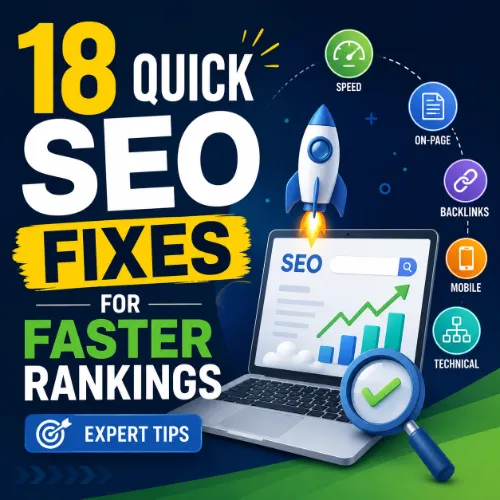
Below are 18 proven tactics, each with a clear explanation and a step you can take within minutes.
1. Fix Duplicate or Missing Title Tags
Why it works: Title tags are the first thing users see in SERPs. Duplicates confuse search engines and lower relevance signals.
Implementation step: Use a tool like Ahrefs Site Audit to export all pages with missing or duplicate titles. Write unique, keyword-rich titles for each URL.
2. Optimize Meta Descriptions for CTR
Why it works: A compelling meta description increases organic click-through rate, which indirectly signals relevance to search engines.
Implementation step: For your top 20 landing pages, rewrite meta descriptions to include the primary keyword and a clear value proposition or call to action.
3. Compress Images Without Losing Quality
Why it works: Large images slow down page load, hurting both user experience and Core Web Vitals scores.
Implementation step: Run all images through TinyPNG or use a WordPress plugin like Smush. Set dimensions to match your content area.
4. Add Internal Links to Orphan Pages
Why it works: Orphan pages (no internal links pointing to them) are rarely crawled, so they cannot rank.
Implementation step: Use Google Search Console or a crawling tool to find pages with zero internal links. Add 2-3 contextual links from relevant articles or category pages.
5. Refresh Old Blog Posts with New Data
Why it works: Search engines favor updated content. Adding recent statistics, examples, or a new section signals freshness.
Implementation step: Pick 5 articles older than 12 months. Update the publish date (only if meaningful changes were made), add new stats, and improve internal linking.
6. Fix Broken Links (Internal and External)
Why it works: Broken links waste link equity and frustrate users, increasing bounce rate.
Implementation step: Use Ahrefs Broken Link Checker or a WordPress plugin. Replace each broken link with a working alternative or remove it.
7. Reduce Redirect Chains
Why it works: Each redirect adds a hop that slows page load and dilutes link equity.
Implementation step: Use a site audit tool to identify chains longer than 2 hops. Directly link the final destination URL instead.
8. Add Schema Markup for Rich Results
Why it works: Structured data helps search engines understand your content, often leading to enhanced SERP features like star ratings or FAQs.
Implementation step: For articles, add Article schema (or FAQ schema if applicable) using a plugin like Rank Math or manually via JSON-LD.
9. Speed Up Your Largest Contentful Paint (LCP)
Why it works: LCP is a Core Web Vitals metric that directly affects rankings. A fast LCP reduces bounce rates.
Implementation step: Use PageSpeed Insights to identify the largest element on a slow page. Optimize that image or text block, and consider lazy loading off-screen elements.
10. Write Unique Meta Titles for Every Page
Why it works: Duplicate titles cause search engines to guess which page to rank, lowering visibility for all duplicates.
Implementation step: Export your site’s titles via a crawler. Find duplicates and rewrite each one to target a distinct keyword or intent.
11. Use Descriptive Alt Text on All Images
Why it works: Alt text helps search engines understand image content, and improves accessibility.
Implementation step: For every image in your content, write a concise description that includes a relevant keyword naturally. Avoid keyword stuffing.
12. Improve Your Click-through Rate with Better Headlines
Why it works: Higher CTR tells Google that your snippet is relevant, which can boost rankings.
Implementation step: Review your top 10 underperforming pages (low CTR in GSC). Test headlines with numbers, questions, or emotional triggers.
13. Remove or Noindex Thin Content Pages
Why it works: Pages with very little content (e.g., tag pages, thin affiliate pages) dilute your site’s overall quality score.
Implementation step: Identify pages with fewer than 300 words and low traffic. Either merge them into richer content or add a noindex tag.
14. Enable Brotli Compression
Why it works: Brotli compresses text files (HTML, CSS, JS) better than Gzip, reducing load time.
Implementation step: Contact your hosting provider or add the following to your .htaccess file (if using Apache): AddOutputFilterByType BROTLI_COMPRESS text/html text/css text/javascript.
15. Fix Mobile Usability Issues
Why it works: Google uses mobile-first indexing. Sites with poor mobile experience rank lower.
Implementation step: Open the Mobile Usability report in Google Search Console. Identify elements (e.g., buttons too close, small fonts) and fix them using responsive CSS.
16. Add a Table of Contents to Long Articles
Why it works: A ToC improves user experience and can generate jump-to links in the SERP.
Implementation step: Use a WordPress plugin like Easy Table of Contents or add anchored headings manually. Ensure each H2/H3 has an ID.
17. Optimize Your Robots.txt and Sitemap
Why it works: These files guide search engine crawlers to your most important pages and away from low-value ones.
Implementation step: Check your robots.txt for disallowed important pages. Submit your XML sitemap to Google Search Console. Ensure it contains only indexable, canonical URLs.
18. Implement 301 Redirects for Deleted Pages
Why it works: A 301 passes link equity to the new page and preserves user experience.
Implementation step: Whenever you delete a page, set up a 301 redirect to the most relevant existing page. Use a redirect plugin or server-level rules.
SEO Entities and Their Functions
Understanding the entities behind these quick SEO fixes helps you make better decisions. Here are the key entities and what they do for your site:
- Website / Domain entities — Root domain, subdomain, and URL-level analysis identify whether performance belongs to the whole site, a section like blog.example.com, or a single page such as example.com/page.
- Keyword entities — Organic keywords, keyword difficulty (KD), search volume, and SERP features show demand, competition, and ranking opportunity.
- Backlink entities — Referring domains, dofollow/nofollow links, broken backlinks, and new/lost links explain authority, link quality, and outreach priorities.
- Page entities — Top pages, best by links, best by traffic, and broken pages reveal which URLs earn visibility, links, traffic, or need repair.
- Content entities — Articles, authors, topics, published dates, social shares, and referring domains help evaluate editorial quality and engagement.
- SERP entities — Featured snippets, People Also Ask, sitelinks, AI Overviews, and local packs show what content format the search result rewards.
- Technical SEO entities — Crawl issues, redirect chains, canonicals, duplicate content, Core Web Vitals, and indexability status expose obstacles.
- Competitor entities — Competing domains, content gap opportunities, shared keywords, and competing pages show where rivals win traffic.
- Link building entities — Link opportunities, broken link prospects, unlinked mentions, and outreach targets turn analysis into prospect lists.
- Metrics entities — DR (Domain Rating), UR (URL Rating), traffic value, organic traffic, and referring domains count summarize authority and visibility.
Useful Resources
- Ahrefs Site Audit — Use it to uncover technical issues like duplicate titles, broken links, and redirect chains. Visit Ahrefs Site Audit.
- Google PageSpeed Insights — Analyze and get specific suggestions to improve LCP, FID, and CLS. Open PageSpeed Insights.
Frequently Asked Questions About quick SEO fixes
How long do quick SEO fixes take to show results?
Some fixes, like fixing broken links or improving meta descriptions, can show impact in a few days. Others, like content refresh, may take a week or two to reflect in rankings. For a related guide, see 28 Technical SEO Fixes That Improve Rankings.
Can I do all 18 fixes in one day?
Yes, most of these are single-person tasks. However, fixing image compression or redirect chains for a large site may take a few hours.
Which fix gives the biggest ranking boost?
Fixing duplicate title tags and improving click-through rate with better meta descriptions often produces the most immediate ranking improvement.
Do quick SEO fixes work for e-commerce sites?
Yes. Optimizing product page titles, compressing images, and fixing broken links on category pages are especially effective for online stores.
Do I need a developer for these fixes?
Most fixes can be done by a site owner or marketer without coding skills. Only Brotli compression and some robots.txt changes may require developer help.
Will these fixes hurt my current rankings?
No. These are safe, best-practice changes. Incorrectly implementing redirects or noindex tags could cause temporary drops, but following the steps here is low risk.
How often should I perform these fixes?
Audit your site monthly for broken links, crawl issues, and title tag duplicates. Refresh old content quarterly.
Do I need a premium SEO tool?
Free tools like Google Search Console and PageSpeed Insights cover many of these fixes. Paid tools like Ahrefs accelerate the process.
Can I prioritize certain fixes over others?
Yes. Start with fixes that affect the most pages (e.g., duplicate titles, broken links), then move to smaller improvements like alt text and internal links.
Will fixing images improve Core Web Vitals immediately?
Yes, compressing large hero images often improves LCP within minutes, provided your hosting is fast.
Do these fixes work for local SEO?
Yes. Fixing NAP consistency, adding local schema, and optimizing city-specific landing pages are excellent local quick wins.
What is the most overlooked quick fix?
Adding internal links to orphan pages. Many site owners forget to link to their best content, leaving it uncrawled.
Can I implement schema markup without a plugin?
Yes, by adding JSON-LD code to the
section via your theme’s functions file or header injection plugin.How many internal links per page is ideal?
There is no hard limit, but 2-5 contextual internal links per 500 words is a good range for most content.
Will fixing redirect chains improve crawl budget?
Yes, fewer redirects mean crawlers can access more pages within the same crawl budget, improving indexation.
Can I reuse meta descriptions across similar pages?
No, each meta description should be unique. Duplicate descriptions cause Google to ignore them both.
How do I find orphan pages?
Use a crawler like Screaming Frog or Ahrefs to detect URLs with zero internal links. Compare with your sitemap to confirm.
Should I noindex tag and category pages?
If they add little value, yes. Keep only the most important categories indexed and noindex thin archive pages.
What if my site has thousands of pages?
Apply these fixes in batches, starting with your highest-traffic URLs. Use automated tools to handle bulk changes.
Can these fixes guarantee a #1 ranking?
No. These are foundational improvements that give you a better chance, but rankings depend on competition, backlinks, and search intent alignment.