

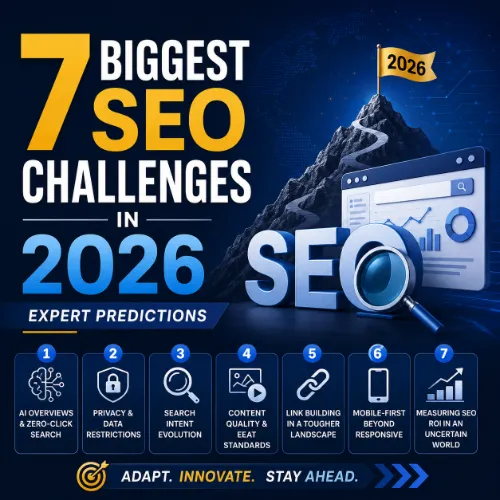
SEO challenges in 2026 Key Takeaways
The world of search constantly evolves, and 2026 will bring distinct SEO challenges in 2026 that demand a strategic shift.
- AI Overviews and conversational search will reshape how users find information, demanding a focus on authoritative, structured content.
- E-E-A-T signals will become even more critical for rankings, requiring transparent authorship and expert-backed information.
- Zero-click searches and diverse SERP features will make it harder to drive organic traffic to your site, emphasizing brand building and snippet optimization.
Google’s Experience, Expertise, Authoritativeness, and Trustworthiness (E-E-A-T) standards continue to tighten. For YMYL (Your Money or Your Life) topics, high E-E-A-T is non-negotiable. However, even non-YMYL content benefits from showing genuine expertise.
Building a Strong E-E-A-T Foundation
This involves multiple elements. Publish author bios with credentials and links to their professional profiles. Include clear citations and references. Regularly update content to maintain accuracy. Encourage genuine customer reviews and mentions from reputable industry sites. These all send strong trust signals to Google.
4. Navigating Voice and Visual Search
Voice search continues to grow through smart speakers and phone assistants. Visual search, powered by tools like Google Lens, is also expanding rapidly. These formats require different optimization strategies than traditional text-based queries. For a related guide, see Why Google Cloud Is Essential for Large Scale SEO Automation in 2026.
For voice search, target long-tail, conversational keywords and structure answers in a Q and A format. For visual search, use high-quality, descriptive image file names, alt text, and structured data. Think about the intent behind a spoken question or a photo snap—it is often immediate and local.
5. Mastering Core Web Vitals and Technical Health
Core Web Vitals remain a ranking signal, but the benchmarks become stricter over time. A slow or visually unstable page will frustrate users and hurt your rankings. This is a fundamental SEO challenges in 2026 because technical debt can silently ruin a good content strategy. For a related guide, see 12 Essential Industry Insights Every SEO Should Understand in 2026.
Prioritizing Technical SEO
Regular site audits are a must. Use tools to check for LCP (Largest Contentful Paint), FID (First Input Delay) / INP (Interaction to Next Paint), and CLS (Cumulative Layout Shift). Hosting, image compression, and efficient code all play a role. Google’s PageSpeed Insights is a free, essential resource for this task.
6. Producing Authentic, Entity-Rich Content at Scale
AI-generated content is now common, but search engines are getting better at detecting low-effort, unoriginal material. The challenge is to produce content that is both scalable and genuinely valuable. Thin content will not survive the coming algorithm updates.
The solution lies in an entity-based writing approach. Instead of focusing only on keywords, build topical authority by covering related entities, concepts, and questions. A well-structured article on a topic should naturally include relevant data, expert opinions, and original research. This is where strategic use of SEO challenges in 2026 analysis provides a competitive edge.
7. Proving SEO ROI in a Zero-Click World
When less traffic comes directly from search results, it becomes harder to attribute value to SEO efforts. Business leaders may question the investment. This is perhaps the most strategic of the SEO challenges in 2026.
Expand your definition of SEO success. Track impressions, brand lift, assisted conversions, and engagement metrics on your site. Use tools like Google Search Console to monitor how often your content appears in SERP features. The value of SEO extends beyond the last click—it builds a digital footprint that influences all channels.
SEO Entities and Their Functions
Understanding the tools and components that affect your search performance is crucial. Here are essential entities and their roles in addressing the SEO challenges in 2026:
- Keyword entities: Metrics like keyword difficulty (KD), search volume, and traffic potential help you prioritize which terms to target for maximum impact.
- Backlink entities: Referring domains, dofollow links, and broken backlinks reveal your site’s authority landscape and where link-building efforts should focus.
- Technical SEO entities: Crawl errors, redirect chains, and Core Web Vitals data expose hidden obstacles blocking your site from achieving top rankings.
- SERP entities: Features like AI Overviews, People Also Ask, and local packs inform what content format and structure the search engine rewards for a given query.
By monitoring these entities, you gain actionable intelligence to refine your strategy and stay ahead of algorithm updates.
Useful Resources
To deepen your understanding of the SEO challenges in 2026 and how to tackle them, explore these trusted sources:
- Google Search Central Blog: Supporting a Healthy Information Ecosystem — Official insights on content quality and E-E-A-T.
- Ahrefs: How to Conduct a Technical SEO Audit — A practical guide for identifying and fixing site health issues.
Conclusion: Embracing Change in SEO
The SEO challenges in 2026 are demanding, but they also create opportunities for those who adapt. The core principles remain: create excellent content for real people, build trust, and maintain a technically sound website. By understanding these seven challenges and taking proactive steps, you can not only survive but thrive in the new search ecosystem. Stay curious, keep testing, and never stop learning.
Frequently Asked Questions About SEO challenges in 2026
What is the biggest SEO challenge in 2026?
The biggest challenge is adapting to AI-driven search, including AI Overviews and zero-click queries, which can reduce organic traffic if not managed strategically.
How will AI change SEO in 2026?
AI will change SEO by prioritizing authoritative, well-structured content that directly answers user queries. Ranking for traditional keywords alone will be less effective.
What are zero-click queries in SEO?
Zero-click queries are searches where the answer appears directly on the results page, often in a featured snippet or knowledge panel, without requiring the user to click a link.
How can I improve my E-E-A-T for SEO in 2026?
Improve E-E-A-T by publishing content from verified experts, providing clear author bios with credentials, citing reliable sources, and regularly updating your content.
Is voice search optimization important for 2026?
Yes. Voice search continues to grow. Optimize by targeting long-tail, conversational keywords and using structured data to provide direct answers.
What are Core Web Vitals and why do they matter?
Core Web Vitals are a set of metrics measuring loading speed, interactivity, and visual stability. They are a ranking signal and a key part of user experience.
How do I prepare for visual search in 2026?
Prepare by using high-quality images, descriptive file names, and detailed alt text. Implementing structured data for images also helps search engines understand them.
What is entity-based SEO?
Entity-based SEO focuses on topics and concepts (entities) rather than just keywords. It helps search engines understand the context and authority of your content.
How can I measure SEO success when clicks are down?
Track impressions, brand mentions, assisted conversions, and how often you appear in SERP features. Use Google Search Console for detailed insights.
What is the role of structured data in 2026 SEO?
Structured data helps search engines understand your content, enabling rich results like FAQ snippets and product carousels. It is essential for visibility in modern SERPs.
Will backlinks still matter in 2026?
Yes. Backlinks remain a strong authority signal. The quality of linking domains matters more than ever, with a focus on relevance and trust.
How often should I update my SEO strategy in 2026?
Review your strategy quarterly. The search landscape changes rapidly due to algorithm updates and new AI features, so flexibility is key.
What is the future of keyword research?
Keyword research will integrate more with entity analysis. Tools will focus on search intent and topic clusters, not just individual keyword lists.
How do I handle duplicate content on my site?
Use canonical tags to tell search engines which version of a page is the primary one. Consolidate similar pages to strengthen your site’s authority.
Is local SEO changing in 2026?
Yes. Local SEO is becoming more personalized, with AI delivering results based on user history and location. Accurate Google Business Profile data is essential.
What role does user engagement play in SEO for 2026?
User engagement signals like dwell time and bounce rate are indirect ranking factors. Creating compelling, easy-to-read content improves these metrics.
Should I use AI to write my SEO content?
Use AI as a drafting assistant, but always add human oversight, original insights, and expert review. Pure AI content may be flagged as low-quality.
How do I find link-building opportunities in 2026?
Use tools to find broken backlinks on relevant sites, identify unlinked brand mentions, and analyze competitor link profiles for opportunities.
What is a content gap analysis?
It is the process of identifying topics your competitors rank for but you do not. Filling these gaps with better content helps you capture new traffic.
How can I future-proof my SEO career?
Commit to continuous learning. Follow industry leaders, attend webinars, and experiment with new tools. Adaptability is the most critical skill for navigating SEO challenges in 2026.







