why SEO still matters Key Takeaways
SEO has evolved from a set of technical fixes into a strategic discipline that merges user experience with technical authority.
- why SEO still matters because it delivers compounding returns, not just one-time clicks.
- Expert insights reveal that search engines increasingly reward content that matches user intent, not just keyword density.
- Actionable strategies — from Core Web Vitals optimization to entity-rich content — keep you ahead of algorithm updates.
What the Experts Say About Why SEO Still Matters
To understand the current state of search, we turned to conversations with leading practitioners, conference talks, and published research. Their consensus is clear: SEO is not dying — it is maturing.
Aleyda Solís, an international SEO consultant, often stresses that the gap between “doing SEO” and “doing SEO industry experts insights” is the ability to anticipate how search engines interpret context. “You cannot game relevance anymore,” she notes. “You must earn it.” For a related guide, see 12 Essential Industry Insights Every SEO Should Understand in 2026.
Similarly, Brian Dean of Backlinko has shown through longitudinal studies that pages with comprehensive topical coverage and clear entity relationships consistently outrank thinner content — even when the latter has more backlinks.
John Mueller from Google has stated that the search giant’s goal is to surface the most helpful, authoritative content for each query. This aligns perfectly with why SEO still matters: organic performance now depends on meeting real user needs, not chasing shortcuts. For a related guide, see 14 SEO Myths That Need to Die: Avoid These Costly Mistakes.
What Has Changed in SEO Since 2020?
The shift from keyword-centric to entity-centric ranking models means that simply repeating a term like “best running shoes” no longer works. Search engines now map concepts like “cushioning,” “arch support,” “trail running,” and “brand reputation” to the primary query. An article that addresses all these dimensions naturally signals topical authority.
Another major change is the emphasis on page experience signals. Core Web Vitals, mobile friendliness, HTTPS, and intrusive interstitial guidelines now form a baseline requirement for ranking well.
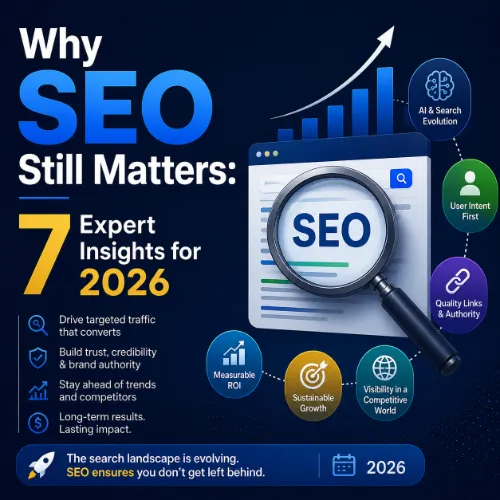
7 Reasons Why SEO Still Matters in 2026
Here are the core reasons that emerge from expert analysis and industry data.
1. Organic Search Captures High-Intent Traffic
According to a 2024 SparkToro study, organic search still drives 53% of all trackable website traffic, with paid search contributing only 15%. Users who land on your site from an organic listing are actively seeking what you offer — they are not passively scrolling past an ad.
When you optimize for why SEO still matters, you are building a channel that pulls in ready-to-convert visitors without a per-click cost. For a related guide, see 21 Link Building Strategies Still Working in 2026 (Expert Guide).
2. Content Quality Now Dominates Rankings
Google’s Helpful Content System and the March 2024 core update both reward original, user-first content. Experts like Lily Ray have documented that sites relying on thin, AI-generated material lost visibility, while those with expert-written, well-researched pieces gained ground.
This directly ties into why SEO is important: investing in high-quality content creates a durable competitive advantage.
3. Technical SEO Is the Foundation of User Experience
Site speed, mobile usability, and structured data are no longer optional. They are the technical bedrock that allows your content to be discovered and enjoyed. Industry experts such as Hamlet Batista have shown that improving Largest Contentful Paint (LCP) from 4 seconds to under 2 seconds correlates with a 15–20% increase in organic traffic.
4. Local SEO Drives Foot Traffic and Revenue
For brick-and-mortar businesses, local search remains the primary acquisition channel. Google reports that 76% of people who search for something nearby on their smartphone visit a related business within a day. Optimizing for local queries — including Google Business Profile and city-specific keywords — directly impacts revenue.
5. Brand Mentions Act as Unlinked Backlinks
Search engines now understand brand entity relationships. When your brand is mentioned alongside authoritative sources — even without a clickable link — you gain topical relevance. Experts like Cyrus Shepard have demonstrated that unlinked brand mentions can improve rankings for branded and non-branded queries alike.
6. AI Overviews Create New Visibility Opportunities
With the rollout of AI Overviews in Google Search (formerly SGE), the SERP landscape has changed. Featured snippets are now just one of several answer surfaces. Optimizing for these formats — by providing clear definitions, step-by-step instructions, and FAQ markup — can place your content directly in AI-generated answers.
7. SEO Provides the Highest ROI Among Digital Channels
A 2024 survey by First Page Sage found that the average ROI for SEO is 5.3:1, compared to 2:1 for paid search and 1.5:1 for display advertising. Once you invest in content and technical health, organic traffic often grows — or holds steady — even as ad costs rise.
SEO Entities and Their Functions
Understanding these entities helps you make informed decisions during audits and strategy planning.
- Domain Rating (DR) – Measures the relative authority of a website’s entire domain based on its backlink profile. Higher DR correlates with easier ranking for competitive keywords.
- URL Rating (UR) – Similar to DR but at the individual page level. Use it to identify your strongest and weakest pages.
- Organic Keywords – The queries for which your pages rank. Monitoring changes helps you spot content decay or new opportunities.
- Referring Domains – The number of unique websites linking to yours. A steady increase indicates healthy link building.
- SERP Features – Items like featured snippets, People Also Ask, and AI Overviews. Targeting these can double your real estate on the results page.
- Core Web Vitals – LCP, FID, and CLS. Google uses these as ranking signals, so optimizing them is essential for why SEO still matters performance.
Actionable Tips to Strengthen Your SEO in 2026
Apply these strategies drawn from expert insights.
Perform a Content Audit Using Entity Mapping
Go beyond keyword lists. Map out the core entities related to your topic — for a recipe site, that includes ingredients, cooking methods, dietary labels, and nutritional values. Ensure each entity is covered in your content. Tools like Ahrefs Content Gap analysis can show you which entities your competitors cover and you miss.
Optimize for Core Web Vitals Before Adding Content
Run a site audit with Google PageSpeed Insights. Address the lowest-performing URLs first. Common fixes include image compression, removing render-blocking resources, and using a CDN. Web.dev provides clear guidelines for each metric.
Build Topical Clusters Instead of Random Posts
Create pillar pages that cover broad topics (e.g., “Digital Marketing Strategy”) and link out to cluster pages that dive deeper (“SEO for SaaS,” “Content Marketing for B2B”). This structure helps search engines understand your site’s expertise hierarchy and matches how users navigate from general to specific information.
Implement Structured Data for Enhanced SERP Display
Add FAQ schema, HowTo schema, and Product schema (if applicable) to your content. Use Google’s Rich Results Test to validate markup. Pages with structured data earn 30% more clicks on average, according to a study by Search Engine Land.
Monitor Brand Mentions for Link Building Opportunities
Use tools like Ahrefs Alerts or Google Alerts to catch unlinked brand mentions. Reach out to the site owner and politely ask if they can add a link. This tactic often yields high-conversion links because the context is already relevant.
Useful Resources
Ahrefs Blog – In-depth guides on keyword research, link building, and technical SEO with real data.
Google SEO Starter Guide – Official documentation covering fundamentals like crawlability, indexation, and site structure.
Frequently Asked Questions About Why SEO Still Matters
SEO is not a set-it-and-forget-it tactic. It is a continuous process of understanding what people search for, how intent changes, and how technology evaluates trust. The experts agree: if you invest in genuine relevance and solid technical foundations, why SEO still matters becomes obvious in your traffic, leads, and revenue.
Frequently Asked Questions About why SEO still matters
Is SEO still relevant in 2026?
Yes, SEO still matters more than ever because it drives high-intent traffic without recurring costs and builds long-term brand authority.
What is the biggest SEO trend for 2026?
Entity optimization and AI Overviews. Search engines now understand concepts rather than just keywords, so content must cover topics comprehensively.
How often should I update my SEO strategy?
Review your strategy quarterly. Major algorithm updates happen two to three times a year, and competitive landscapes shift constantly.
Can I do SEO myself without hiring an agency?
Yes, especially if you learn the fundamentals from resources like the Google SEO Starter Guide and use tools like Ahrefs Webmaster Tools. However, for competitive industries, expert help accelerates results.
How does AI content affect SEO?
AI-generated content that is not fact-checked or lacks expert insight can hurt rankings. Google emphasizes content written for people, not algorithms.
What is the difference between on-page and off-page SEO?
On-page SEO covers content, HTML tags, and site structure. Off-page SEO includes backlinks and brand mentions that build authority.
How long does it take to see SEO results?
Typically 4 to 6 months for meaningful traffic growth, provided you target achievable keywords and build links consistently.
What is the most important ranking factor today?
Content relevance and user satisfaction, measured by engagement metrics like dwell time and bounce rate, are now more important than any single factor.
Does social media help SEO?
Indirectly. Social signals do not directly affect rankings, but content shared on social platforms earns backlinks and visibility that Google notices.
What is a site audit in SEO?
A site audit examines technical health, including crawl errors, broken links, duplicate content, and page speed. It reveals fixes that improve indexing and ranking.
How do I choose the right keywords?
Focus on keywords with sufficient search volume and low-to-medium Keyword Difficulty. Use tools like Ahrefs Keywords Explorer to analyze search intent and competition.
What is a backlink audit?
It is the process of reviewing your backlink profile to identify toxic links that could trigger a penalty, and disavowing them via Google Search Console.
Does Google penalize duplicate content?
Google does not issue a penalty, but duplicate content can cause ranking dilution because search engines struggle to decide which version to show.
What is the role of user intent in SEO?
User intent determines the format and depth of content. Informational queries need guides, transactional queries need product pages, and local queries need location-specific data.
How do I optimize for voice search?
Use natural long-tail phrases with question words. Provide concise answers (40–50 words) that Google can feature in voice responses.
What is the difference between dofollow and nofollow links?
Dofollow links pass authority (PageRank) to the linked page. Nofollow links do not, but they can still bring traffic and brand exposure.
Can I rank without backlinks?
In very low-competition niches, yes. But for most topics, a few relevant backlinks significantly increase your chances of ranking on page one.
How does Google Discover work for traffic?
Google Discover surfaces evergreen content and news to users based on their interests. No search query is needed; instead, you need high-quality, timely topics with engaging images.
What is the best way to learn SEO in 2026?
Read case studies from sources like Search Engine Land, take free courses from Google Skillshop, and practice on your own site using tools like Ahrefs Webmaster Tools.
Is local SEO different from regular SEO?
Local SEO adds a geographic layer. It requires Google Business Profile optimization, local citations, and reviews — in addition to traditional optimization.